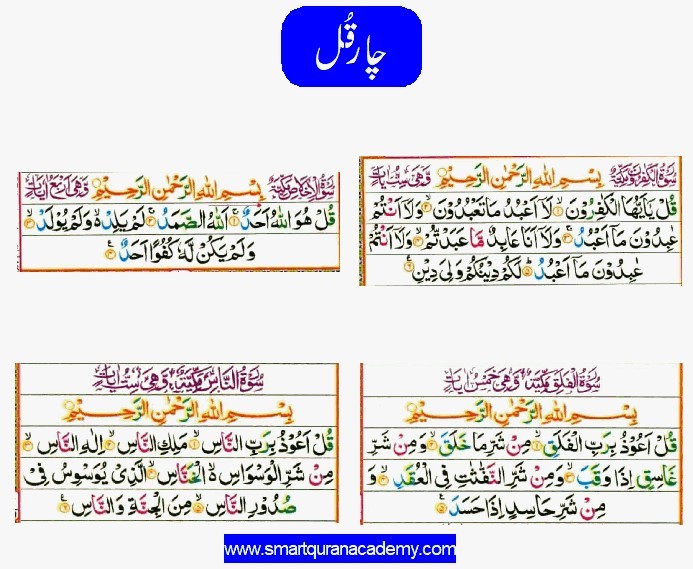
What are the Four Quls?
The term “Four Quls” refers to four short chapters of the Quran that begin with the Arabic word “Qul” (قُل), meaning “Say”. In these Surahs, Allah commands Prophet Muhammad (ﷺ) to proclaim important truths about faith, worship, and seeking His protection.
The Four Quls are:
| Surah | Chapter Number | Main Theme |
| Surah Al-Kafirun | 109 | Sincerity in worship and rejection of false beliefs |
| Surah Al-Ikhlas | 112 | The absolute Oneness of Allah |
| Surah Al-Falaq | 113 | Seeking Allah’s protection from external harm |
| Surah An-Nas | 114 | Seeking Allah’s protection from internal whispers and Satan |
Although each Surah addresses a different subject, together they strengthen a believer’s faith and remind Muslims to rely completely on Allah in every situation. Through an online Quran programme, students can learn from every part of the world.
Why are they called the Four Quls?
The Arabic word “Qul” means “Say”. Allah begins each of these chapters by instructing the Prophet Muhammad (ﷺ) to declare a message openly.
Each Surah begins with the following:
- قُلْ يَا أَيُّهَا الْكَافِرُونَ
- قُلْ هُوَ اللَّهُ أَحَدٌ
- قُلْ أَعُوذُ بِرَبِّ الْفَلَقِ
- قُلْ أَعُوذُ بِرَبِّ النَّاسِ
You can get all the information from a trusted Quran academy.
Surah Al-Kafirun (Chapter 109)
Surah Al-Kafirun was sent down in Makkah when the Quraysh were trying to convince Prophet Muhammad (ﷺ) to bow down to their religion and abandon Islam. They suggested that they should worship their idols for a year and then worship Allah for another year.
This Surah was revealed as a clear statement to those who wanted to make compromises in matters of worship.
Arabic Text
بِسْمِ اللَّهِ الرَّحْمَٰنِ الرَّحِيمِ
قُلْ يَا أَيُّهَا الْكَافِرُونَ
لَا أَعْبُدُ مَا تَعْبُدُونَ
وَلَا أَنْتُمْ عَابِدُونَ مَا أَعْبُدُ
وَلَا أَنَا عَابِدٌ مَا عَبَدْتُمْ
وَلَا أَنْتُمْ عَابِدُونَ مَا أَعْبُدُ
لَكُمْ دِينُكُمْ وَلِيَ دِينِ
Transliteration
Bismillahir Rahmanir Raheem
Qul yā ayyuhal-kāfirūn.
Lā aʿbudu mā taʿbudūn.
Wa lā antum ʿābidūna mā aʿbud.
Wa lā anā ʿābidum mā ʿabattum.
Wa lā antum ʿābidūna mā aʿbud.
Lakum dīnukum wa liya dīn.
English Translation
In the name of Allah the Compassionate, the Merciful.
1. Say, O disbelievers,
2. I do not worship what you worship.
3. Nor are you worshippers of what I worship.
4. Nor will I be a worshipper of what you have worshipped.
5. Nor will you be worshippers of what I worship.
6. Yours is your religion, and mine is my religion.
Meaning of Surah Al-Kafirun
Surah Al-Kafirun is the statement of allegiance to Allah alone. It exposes the Muslims to the fact that faith cannot be combined with something against the Islamic tenets. Allah stated that the worship of Allah cannot be divided into two when the Quraysh invited the Prophet (ﷺ) to compromise.
The last verse, “For you is your religion, and for me is my religion,” does not mean “For you is your religion; make sure it is the true one.” Rather, it establishes clearly that the Muslims are steadfast in Islam and do not compromise it.
This Surah brings to the believer’s mind the reminder that faith must be sincere, even in the face of pressure and opposition in society.
Surah Al-Ikhlas (Chapter 112)
Surah Al-Ikhlas is one of the unique chapters that are not found in any other chapters in the Quran. It is composed of just four verses, but it is a summary of one of the most basic beliefs in Islam, the Oneness of Allah (Tawheed). This Surah is a message that every Muslim must know, be they children or adults or those who are knowledgeable or not.
Al-Ikhlas is a literal translation that means “sincerity” or “purity of faith“. The word “Ikhlas” is not mentioned in the Surah, but it was named after it because it offers the lesson of having no partners with Allah.
This Surah is one of the Surahs that are recited many times during the daily Salah and is one of the first Surahs that children learn to memorize.
Arabic
بِسْمِ اللَّهِ الرَّحْمَٰنِ الرَّحِيمِ
قُلْ هُوَ اللَّهُ أَحَدٌ
اللَّهُ الصَّمَدُ
لَمْ يَلِدْ وَلَمْ يُولَدْ
وَلَمْ يَكُن لَّهُ كُفُوًا أَحَدٌ
Transliteration
Bismillāhir-Raḥmānir-Raḥīm
Qul huwa Allāhu Aḥad.
Allāhus-Ṣamad.
Lam yalid wa lam yūlad.
Wa lam yakun lahu kufuwan aḥad.
English Translation
In the name of Allah, the Most Compassionate, the Most Merciful.
1. Say, “He is Allah, the One.
2. Allah, the Eternal Refuge.
3. He neither begets nor is born.
4. Nor is there anyone comparable to Him.
Meaning of Surah Al-Ikhlas
Surah Al-Ikhlas gives a complete and clear description of the uniqueness of Allah.
The first verse, “He is Allah, the One,” states that Allah is absolutely One in His Lordship, worship, and His attributes. The only God that can be worshipped is Him.
In the second verse, Allah is described as As-Samad, the One who is relied on by none and who relies on no one to rely on. Allah’s mercy, guidance, shelter and sustenance are needed for all the living creatures, but Allah does not need His creation.
The third verse refutes the notion that Allah has children or parents. Unlike human beings, Allah was neither born nor does He give birth. He was and is, and ever shall be.
The last verse stresses the point that there is nothing and no one like Allah. His knowledge and his power, his mercy and his greatness are beyond compare.
All four verses taken together encapsulate the core of Islamic faith and save Muslims from wrong beliefs about Allah.
Surah Al-Falaq (Chapter 113)
Surah Al-Ikhlas tells the Muslim people who Allah is, while Surah Al-Falaq tells the believers where they can seek protection.
Numerous dangers in life are not only obvious but also not-so-obvious. Some are physical, and others spiritual or emotional. Allah is the only one who protects.
Surah Al-Falaq is one of the Mu’awwidhat, the chapters of the Quran that were revealed for particular protection from various types of evil.
Arabic
بِسْمِ اللَّهِ الرَّحْمَٰنِ الرَّحِيمِ
قُلْ أَعُوذُ بِرَبِّ الْفَلَقِ
مِن شَرِّ مَا خَلَقَ
وَمِن شَرِّ غَاسِقٍ إِذَا وَقَبَ
وَمِن شَرِّ النَّفَّاثَاتِ فِي الْعُقَدِ
وَمِن شَرِّ حَاسِدٍ إِذَا حَسَدَ
Transliteration
Bismillāhir-Raḥmānir-Raḥīm
Qul aʿūdhu birabbil-falaq.
Min sharri mā khalaq.
Wa min sharri ghāsiqin idhā waqab.
Wa min sharrin-naffāthāti fil-ʿuqad.
Wa min sharri ḥāsidin idhā ḥasad.
English Translation
In the name of Allah, the Most Compassionate, the Most Merciful.
1. Say, “I seek refuge in the Lord of the daybreak.
2. From the evil of what He has created,
3. And from the evil of the darkness when it settles,
4. And from the evil of those who blow on knots,
5. And from the evil of an envier when he envies.
Meaning of Surah Al-Falaq
In this Surah, Allah taught the Muslims to ask Him for protection from all sorts of external harms.
The Surah opens with the title “The Lord of Daybreak”. The Lord is Allāh. Allāh can remove every difficulty, just like Allāh brings light after darkness; Allāh has the power to protect His servants from every hardship.
Cause of Harm
In the second verse, all the evil that exists within creation, both known and unknown, is included.
The third verse speaks about the perils of darkness, when many bad things can happen. Through our flexible online Quran learning academy, students can study from anywhere in the world while receiving personalized attention.
The fourth verse is asking Allah to be their guardian against the harm that is hidden from them. In Islamic education, Muslims are taught to take recourse to Allah alone on these things and not to be too afraid of them. The last verse is about envy (Hasad), and that in itself can cause harm unless Allah protects it.
Lessons We Learn from Surah Al-Falaq
Allah alone is our protector. In all difficulties, Muslims put their trust in Allah first of all. By fleeing to Him, a person enhances his faith and is reminded that the ultimate safety is with Allah.
Evil Exists, But Allah’s protection is greater
Islam admits that jealousy, bad intentions, and other unseen trials exist. But the believer is not to live in fear. Rather, they should keep in mind Allah regularly, recite the authentic supplications, and rely on Allah’s protection.
There is a risk of people and communities being negatively affected by jealousy. Hasad is the ruin of relationships, resentment, and the taking away of blessings from the land.
Islam asks Muslims to cleanse their hearts, not be envious of others, and pray for them rather than for the dispensation of their blessings.
The True Characteristics of Surah Al-Falaq
The Prophet (ﷺ) used to recite Surah Al-Falaq with Surah An-Nas and Surah Al-Ikhlas in the morning, evening, and before sleep.
There are also authentic Hadiths recording that when he used to read these chapters, he would gently blow into his hands and wipe them on his body, and then he would go to sleep.
In these practices, there is a clear sign that seeking Allah’s protection through what He revealed in the Quran is an important practice. Excellent. Here’s the final part of the article.
Surah An-Nas (Chapter 114)
Surah An-Nas is the last surah of the Holy Quran and ends the message of protection which started with Surah Al-Falaq. Surah Al-Falaq is strongly about being protected from external threats, whereas Surah An-Nas is strongly about seeking refuge from the internal threats, namely the whispers of Shaytan.
We all have times when we struggle with doubt, temptation, fear, anger, or negative thoughts, and these are times when we are Muslims. We are Muslims and have had, and will have, times of doubt, temptation, fear, anger, or negative thoughts. Islam has confirmed that many of these whispers are from Shaytan (the demon), whose purpose is to pull people away from the remembrance of Allah. In the Surah of An-Nas, Allah offers a great supplication to remind the believers to seek it at all times.
Arabic
بِسْمِ اللَّهِ الرَّحْمَٰنِ الرَّحِيمِ
قُلْ أَعُوذُ بِرَبِّ النَّاسِ
مَلِكِ النَّاسِ
إِلَٰهِ النَّاسِ
مِن شَرِّ الْوَسْوَاسِ الْخَنَّاسِ
الَّذِي يُوَسْوِسُ فِي صُدُورِ النَّاسِ
مِنَ الْجِنَّةِ وَالنَّاسِ
Transliteration
Bismillāhir-Raḥmānir-Raḥīm
Qul aʿūdhu birabbin-nās.
Malikin-nās.
Ilāhin-nās.
Min sharril-waswāsil-khannās.
Alladhī yuwaswisu fī ṣudūrin-nās.
Minal-jinnati wan-nās.
English Translation
In the name of Allah, the Most Compassionate, the Most Merciful.
1. Say, “I seek refuge in the Lord of mankind.
2. The Sovereign of mankind,
3. The God of mankind,
4. From the evil of the retreating whisperer,
5. Who whispers into the hearts of mankind,
6. Whether from among the jinn or mankind.
Contextual Meaning
Allah greets him with three beautiful attributes:
The Lord of mankind – The One who created, nurtured and cared for man.
These three descriptions are all reminders to the believers that the One who is in control of all things is also the One who can protect them from all unseen dangers.
The Surah also contains a warning to beware of Al-Waswas Al-Khannas, a whisperer who constantly brings evil suggestions but withdraws when Allah is remembered.
Such whispers can be a way to induce a person to commit sin, to doubt, to become arrogant, to fall into jealousy, or to despair. Allah teaches us the latter is guarded by constant remembrance (Dhikr), sincere duas and recitation of the Quran. As a trusted online Quran academy, we provide one-to-one learning with experienced teachers who make Quran education engaging and accessible.