The 6 Kalimas are of special importance in the learning of Islam. They help the Muslims to know the fundamentals of the teachings of Islam, such as the Oneness of Allah, the Prophethood of Muhammad (PBUH), the importance of praising Allah, seeking his forgiveness, and protecting their faith from disbelief. The 6 Kalimas are taught to children and adults as part of their fundamental Islamic education. The memorization and comprehension of these Kalimas develop faith in the Muslim and enhance their relationship with Islam. Many students join an online Quran academy to learn the 6 Kalimas with proper pronunciation, understanding, and authentic Islamic guidance.
Learning the 6 Kalimas helps Muslims strengthen their faith, understand the foundations of Islam, and develop a closer connection with Allah. Start your learning journey with qualified teachers and learn the 6 Kalimas with correct pronunciation, translation, and understanding from the comfort of your home.
The word “Kalima” means “word” or “statement” or “declaration“. In Islamic education, the 6 Kalimas are six declarations that are considered to be very important in Islam because they encompass the fundamental beliefs and teachings of Islam.
These are Kalimas that discuss some important themes that are the cornerstones of a Muslim’s beliefs. They stress the unity of Allah, the prophethood of Muhammad (ﷺ), the remembrance and exaltation of Allah, the repentance for sins, and the denial of disbelief and falsehood.
The six Kalimas are also called the following:
For centuries, these statements have been important to Islamic education. They are among the first lessons taught to Muslim children since they are a summary of the beliefs that every Muslim should know. Memorization is good, but when this is understood and when lessons from these words are used in daily life, benefit is truly realised.

Laa ilaaha illal Lahoo Mohammadur Rasool Ullah
Allah K Siwa Koi Mabood Nahin Muhammad (S.A.W) Allah K Rasool Hain
There is none worthy of worship except ALLAH, (and) Muhammad (P.B.U.H) is the Messenger of ALLAH.

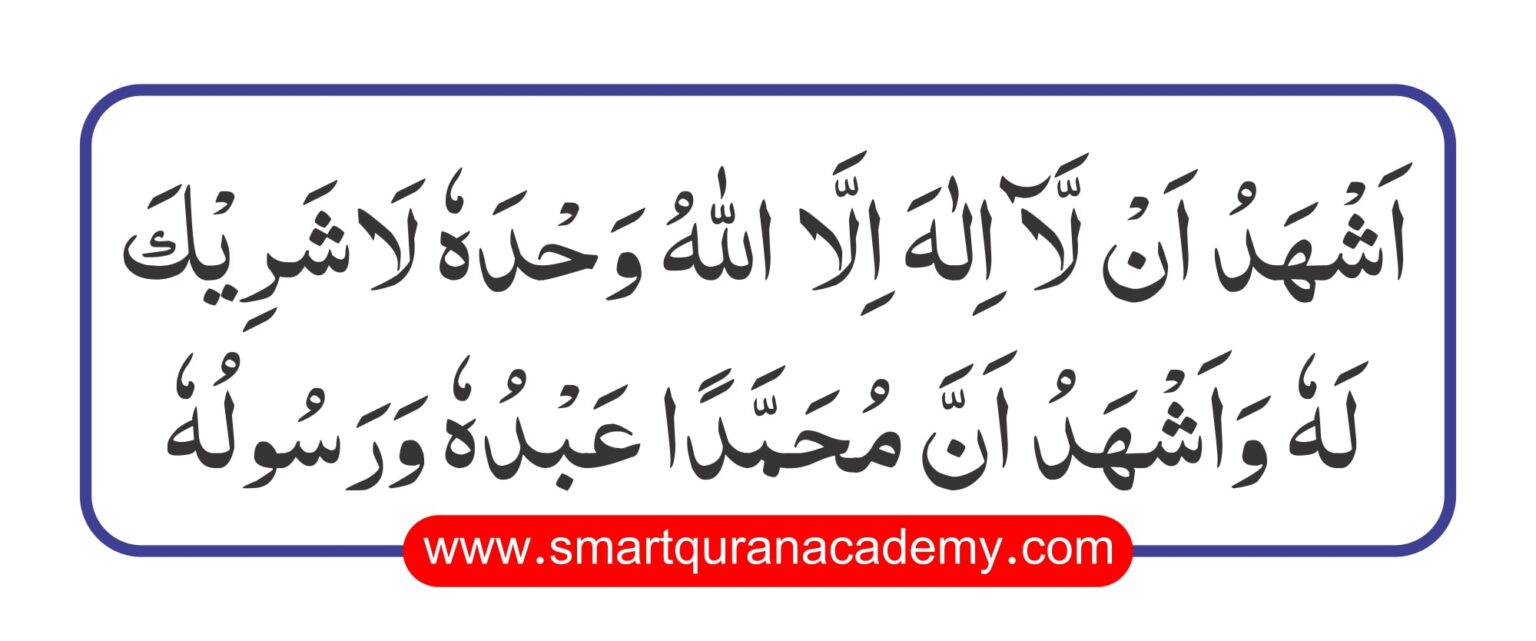
Ashahado An Laa ilaaha illal Laho Wahtha Ho La Shareekala Hoo Wa Ash Hado Anna Mohammadan Abdo Hoo Wa Rasoolohoo.
MEN GAWAHI DETA HUN K ALLAH K SIVA KOI MABOOD NAHIN WO AKELA HAI, USKA KOI SHAREEQ NAHIN OR MEN GAWAHI DETA HUN K MUHAMMAD (S.A.W) USKE BANDEY OR RASOOL HAIN.
I bear witness that there is none worthy of worship except ALLAH, the One alone, without partner, and I bear witness that Muhammad (P.B.U.H) is His Servant and Messenger.

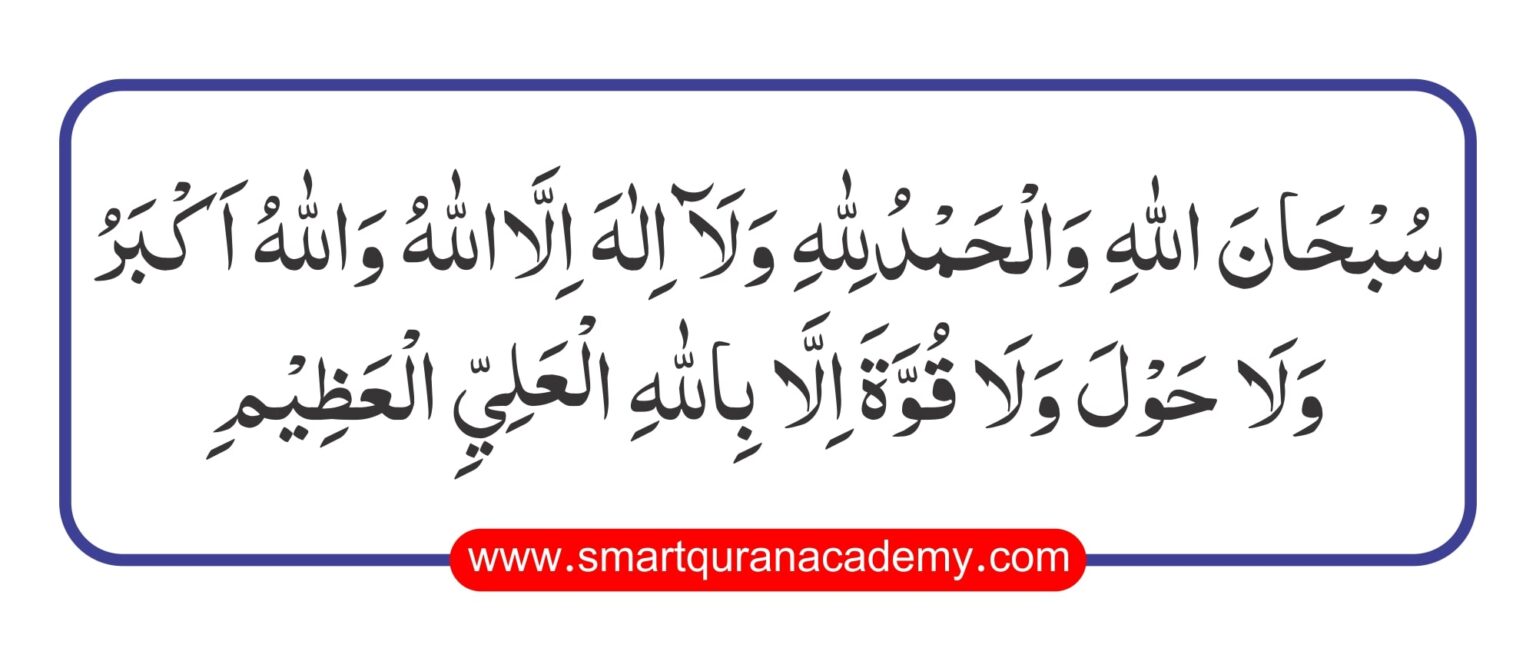
Subhaana laah e Walhamdu Lillaahe Walaaa Ilaaha Illa-llaahu Wallah u Akbar. Walaa Hawla Walaa Quwwata Illaa Billaahi-l ‘Aliyyil ‘Azeem.
ALLAH KI ZAAT PAK HAI OR SAB TAREEFEN ALLAH K LIYE HAIN OR ALLAH K SIVA KOI MABOOD NAHIN OR ALLAH BARA HAI OR GUNAHON SE BACHNE KI TAQAT OR NAIK KAM KRNEY KI TAUFEEQ ALLAH KI JANIB SE HAI JO BUHAT BULAND OR AZMAT WALA HAI.
Glory be to ALLAH and all praise be to ALLAH and there is none worthy of worship except ALLAH, and ALLAH is the Greatest. And there is no might or power except with ALLAH, the Exalted, the Great One.

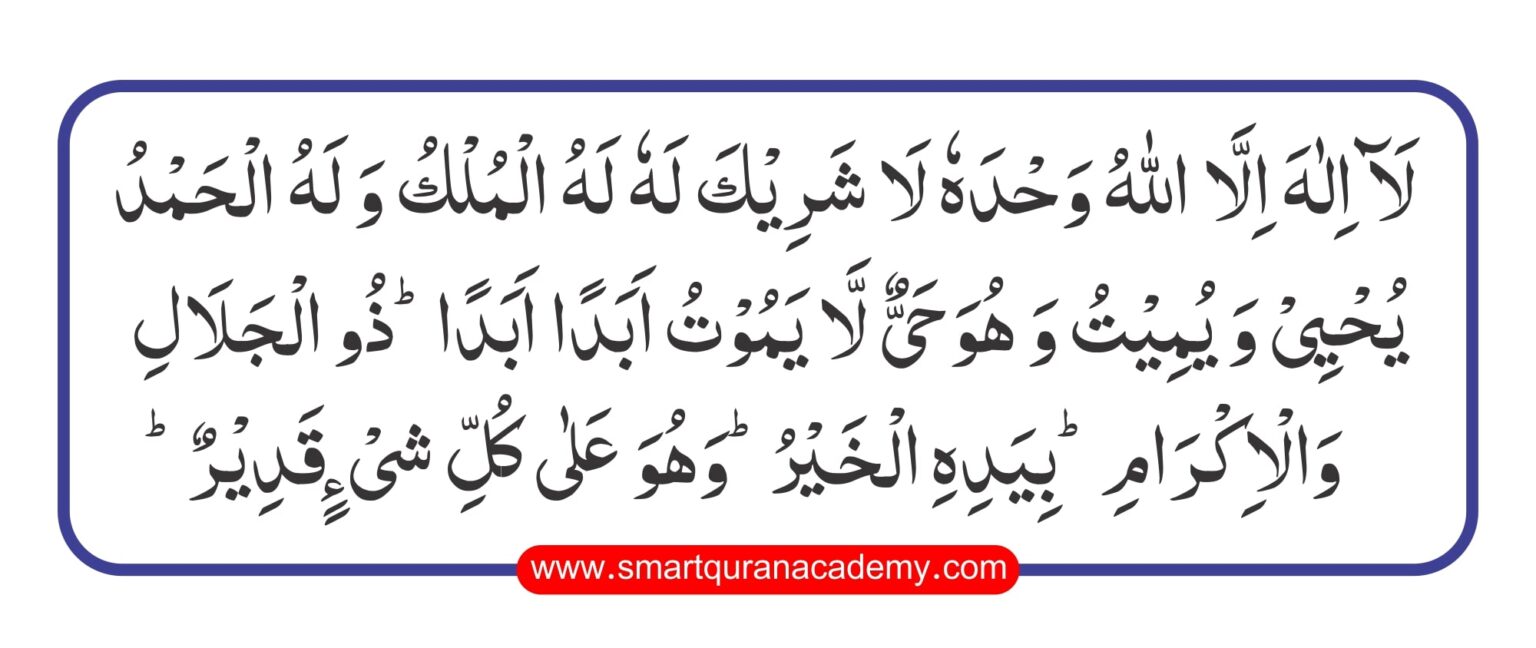
Laa ilaha illal Lahoo Wahdahoo Laa Shareekalahoo Lahul Mulko Walahul Hamdo Yuhee Wa Yumeeto Wa Hoa Haiy Yul La Yamooto Abadan Abada Zul Jalali Wal ikraam Beyadihil Khair. Wa hoa Ala Kulli Shai In Qadeer.
ALLAH K SIVA KOI MABOOD NAHIN, WO AKELA HAI USKA KOI SHAREEQ NAHIN, USI KI BADSHAHI HAI OR USKE LIYE TAMAAM TAREEFEN HAIN. WO ZINDA KRTA OR WOHI MARTA HAI. OR WO HMESHA K LIYE ZINDA HAI, WO MAREGA NAHIN, WOHI AZMAT OR BUZURGI WALA HAI, BEHTARI USI K HATH MEN HAI OR WO HAR CHEEZ PR QADIR HAI.
There is none worthy of worship except ALLAH. He is alone and has no partner. To Him belongs the Kingdom and for Him is all praise. He gives life and causes death. And He is alive. He will not die, never, ever. Possessor of Majesty and Reverence. In His hand is all good and He has power over everything.

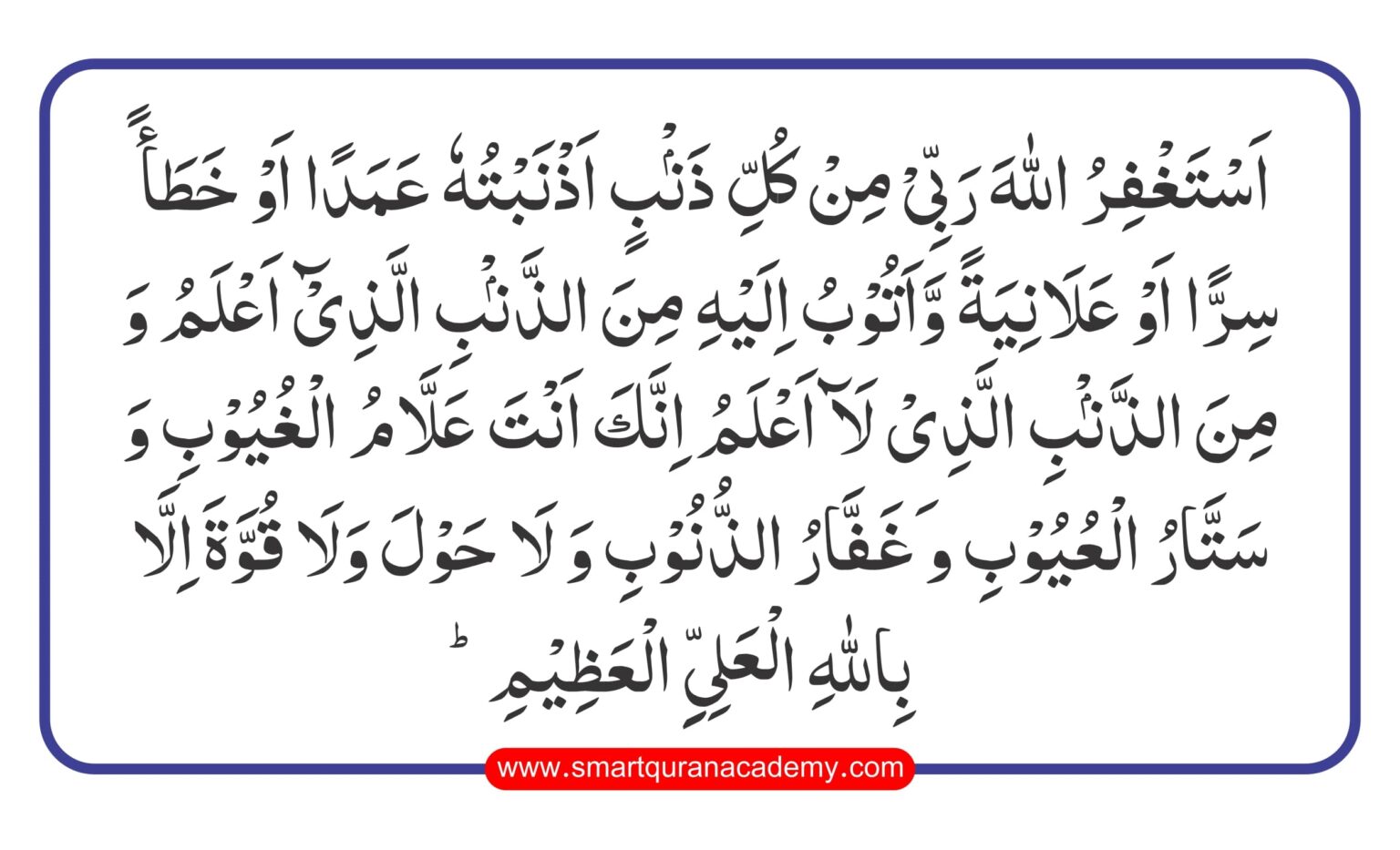
Astaghfirullah Rabbi Min Kullay Zambin Aznabtuho Amadan Ao Khat An Sirran Ao Alaniatan Wa Atoobo ilaihe Minaz Zambil Lazee Aalamo Wa Minaz Zambil Lazee La Aalamo innaka Anta Allamul Ghuyoobi Wa Sattaarul Oyobi Wa Ghaffaruz Zunoobi Wala Haola Wala Quwwata illa billahil AliYil Azeem.
MEN MUAFI MANGTA HUN AE MERE ALLAH HAR GUNAH SE JO MENE JAAN BUJH KR KIYA HAI YA BHOOL KR KIYA HAI, DR PARDA YA KHULAM KHULLA OR MEN TAUBA KRTA HUN USKE HAZOOR MEN US GUNAH SE JO MJE MALOOM HAI OR US GUNAH SE JO MJE MALOOM NAHIN HAI. BESHAQ TU AEBON KO JANNEY WALA OR AEBON KO CHUPANEY WALA HAI. OR GUNAHON SE BAKHSHNEY WALA HAI OR GUNAHON SE BACHNE KI TAQAT OR NAIK KAM KRNEY KI TAQAT ALLAH HI KI TARAF SE HAI. JO SHAN OR AZMAT WALA HAI.
I seek forgiveness from ALLAH, my Lord, from every sin I committed knowingly or unknowingly, secretly or openly, and I turn towards Him from the sin that I know and from the sin that I do not know, Certainly You (O ALLAH!), You (are) the knower of the hidden things and the Concealer (of) the mistakes and the Forgiver (of) the sins. And (there is) no power and no strength except from ALLAH, the Most High, the Most Great.

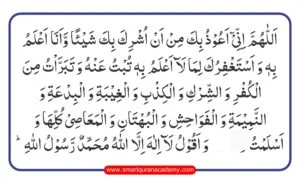
Allah Humma inni Aaoozubika Min An Oshrika Beka Shai Aown Wa Anaa Aalamo Behi Wa Astaghfiroka Lima laa Aalamo Behi Tubtu Anho Wa Tabarrato Minal Kufri Washshirki Wal Kizbi Wal Jheebati Wal Bidaati Wan Nameemati Wal Fawahishi Wal Bohtani Wal Maasi Kulliha Wa Aslamtoo Wa Aamantoo Wa Aqoolo Laa ilaaha illal Lahoo Mohammadur Rasool Ullah.
AE ALLAH MEN PANAH MANGTA HUN IS BAAT SE K MEN KSI KO TERA SHAREEQ BANAON JAAN BUJH KR, OR BAKHSHISH MANGTA HUN MEN TUJHSE US SHIRQ KI JO MEN JANTA NAHIN HUN OR MENE US SY TAUBA KI OR BEZAAR HUA KUFR SE, SHIRQ SE, OR JHOOT SE, OR GHEEBAT SE, OR BIDDAT SE, OR CHUGHLI SE, OR BEHAYAI SE, OR BOHTAAN SE OR TAMAAM GUNAHON SE OR MEN ISLAM LAYA OR MEN KEHTA HUN K ALLAH K SIVA KOI MABOOD NAHIN OR MUHAMMAD (S.A.W) ALLAH K RASOOL HAIN.
O ALLAH! I seek refuge in You from that I should not join any partner with You and I have knowledge of it. I seek Your forgiveness from that which I do not know. I repent from it (ignorance) and I reject disbelief and joining partners with You and of falsehood and slandering and innovation in religion and tell-tales and evil deeds and the blame and the disobedience, all of them. I submit to Your will and I believe and declare: There is none worthy of worship except ALLAH and Muhammad (P.B.U.H) is His Messenger.
The importance of the 6 Kalimas is that they highlight key aspects of Islamic belief in a concise and easy-to-understand way. Islam is not just a collection of religious practices. It is a complete set of beliefs that affects an individual’s thoughts, actions, and intentions. The Kalimas assist Muslims in comprehending this belief system by presenting them with the key concepts that impact Muslims’ relationship with Allah.
The Kalimah reminds the believers of the following four points: firstly, that Allah alone is to be worshipped; secondly, that the Prophet Muhammad (ﷺ) is the last of all messengers; thirdly, Allah should be remembered often; and lastly, that repentance is required to purify the soul.
The First Kalima is perhaps the most important declaration in Islam. It states:
“La ilaha illallahu Muhammadur Rasulullah.”
“There is no god but Allah, and Muhammad is the Messenger of Allah.”
The simple statement is the heart of the Islamic religion. The first part of the Kalima is that Allah alone is worthy of worship. It condemns all forms of polytheism, idolatry, and false worship. A Muslim is determined that Allah is the Creator, Sustainer, and Controller of the universe. The second part is an affirmation of the belief in Prophet Muhammad (ﷺ) as the final messenger sent by Allah to lead mankind.
The Second Kalima further expands on the declaration of faith through the stress laid on testimony and witness. This Kalima is a way for Muslims to declare their faith publicly, stating that Allah is One and Muhammad (ﷺ) is the messenger and servant of Allah.
Of course, the concept of testimony is important, as Islam has called for faith with inner and outer conviction. A believer should believe and manifest it in the heart and in words and deeds. Sincerity is taught by the Second Kalima. It brings the message to the Muslims that their faith is not just handed down from their families or culture. It takes conviction, understanding, and commitment for true belief.
The Third Kalima is about praising and glorifying Allah. Allah’s remembrance (Dhikr) is a major part of Islamic spirituality. Remembrance of Allah has been repeatedly mentioned in the Quran for the believers to remember Allah often, as this remembrance purifies the heart and strengthens their belief. The expressions in the third Kalima are regarding Allah’s perfection, greatness, and power. It reminds Muslims of Allah’s perfection and deservability of all praise.
People get caught up in the worries and responsibilities of modern life and get distracted by other things. Under such conditions, the Third Kalima is a great reminder to connect with Allah. Remembrance brings about an increased awareness of Allah in the life of the Muslim. It can help them to make better choices, to avoid sinful behaviour, and to have a positive attitude even in challenging situations.
The Fourth Kalima is about a fundamental concept in Islam: Tawheed. Tawheed is the statement of the oneness and uniqueness of Allah. It’s the backbone of all the Islamic teachings. In this Kalima, it is said that Allah gives life and causes death, governs all affairs, and has control over everything.
The knowledge of Tawheed changes the outlook of a Muslim. It is a lesson that all is within His command and that no created being is powerful except with Allah’s permission. Muslims who grasp the concept of Tawheed gain faith in Allah when they are in distress, and they gain faith in Allah when they are at ease. They understand that success, provision, health, and guidance are all from Allah.
The Kalima is the fifth prayer that contains the word Allah. The fifth Kalima is the prayer with the word of Allah, which is “Astaghfar”. All people make errors. Islam admits that man is imperfect and offers a way to repent sincerely for his sins and be forgiven. The fifth Kalima is called Astaghfar, which is a call to seek Allah’s forgiveness. It helps the believers recognize their own weaknesses and surrender to Allah with utmost humility and sincerity.
The beauty of Islam is that one of the most important things is that Allah is remembered for His mercy. Allah’s forgiveness is available to everyone, no matter how great their sins are, as long as they are repenting sincerely. The 5th Kalima teaches Muslims that repentance cannot be a weakness. Instead, it is a brave and modest move. It demands self-criticism, remorse, and improvement.
The Sixth Kalima is about rejecting disbeliefs and affirming commitment to the Islamic faith. In the past, believers have encountered challenges to their faith. Sometimes, there is confusion and doubt because of ideas, philosophies, and practices that are different to Islamic teachings. The Sixth Kalima is a statement of allegiance to Islam and a rejection of that which contradicts Tawheed.
This Kalima is a reminder to the Muslims of taking and rejecting. Truth must be accepted with the rejection of falsehood. Believers’ affirmation of belief in Allah and the denial of disbelief are strengthening their spiritual identity and steadfastness in Islam.

Together, the 6 Kalimas are a spiritual path. They take believers through the key stages of faith, remembrance, repentance, and commitment.
In the first and second Kalimas, Muslims say that they believe in Allah and His Messenger. In the third and fourth Kalimas, they worship Allah and make their understanding of His might stronger. In the Fifth Kalima, they ask for forgiveness and purification. In the sixth Kalima, they safeguard their religion and strengthen their belief in Islam.
As with other stages of progression, this helps believers to have a balanced and meaningful relationship with Allah. It motivates them to worship with sincerity, to trust in Allah completely, and to make striving for improvement a habit.
While the Kalimas are a part of many Muslims’ memorization, they might not be able to memorize them or understand their meaning, and they may have trouble with pronunciation. Students can learn the correct and confident recitation of Kalimas from an expert teacher.
Students at our online Quran academy learn:
The experienced teachers offer online tutoring for kids and adults from all over the world. Online Quran programmes help children build a strong Islamic foundation while learning the Quran, daily duas, and the 6 Kalimas from qualified teachers.
You can get Quran classes online with top-notch instructors. Upon learning the 6 Kalimas, students can further their Islamic learning through our structured programmes of learning the Quran.
You can also explore:
These Quran learning programmes aim to teach the students the basics of Islamic knowledge, Tajweed, and the method to say prayer.
These Kalimas have been taught for centuries, and indeed, they are as relevant as ever. The challenges of modern society can be different and can hinder one from focusing on spiritual matters. There is a lack of space for reflection and recollection due to materialism, social pressure, and constant digital immersion.
The 6 Kalimas remind us of the universal truths that are beyond these challenges. They motivate Muslims to stay close to Allah, adhere to their religion, and look to Islamic guidance.
Reflections on the meanings of the Kalimas can help believers to find their way through the challenges of modern life while keeping them firmly in the grip of their faith. The lessons that they convey are universal, and Muslims continue to be guided by them in all times and places.
The 6 Kalimas are one of the most important teachings a Muslim has to learn. They teach the basic principles of the Islamic faith, strengthen Muslims’ belief in Allah, and help them improve their relationship with Islam. Knowing the meanings of the Kalimas and learning the Quran under the proper guidance will help Muslims to enrich their knowledge, enhance their worship, and boost their faith. A trusted Quran academy online can help students learn the 6 Kalimas, understand their meanings, and continue their journey of Quran learning with confidence.
How many Kalimas are there in Islam?
The 6 Kalimas are Islamic statements, supplications, and declarations of faith. They assist Muslims in learning some of the fundamentals of Islam.
What do the 6 Kalimas mean?
The main objective of the 6 Kalimas is to impart the Islamic teachings such as Tajweed, Prophethood, Repentance, and Remembrance of Allah. It builds on the faith of the Muslim and their understanding of Islam to teach them.
Do the 6 Kalimas teach children?
Children are taught the 6 Kalimas, of course, as a part of their Islamic education from an early age. They acquire elements that lead to a good foundation of Islamic values and faith.
Is it necessary to understand the meaning of the Kalimas?
Yes, it is imperative to understand what they mean and as important as remembering. It will help Muslims to carry out the teachings of Kalimas in their daily life and in their worship.
How to easily remember the 6 Kalimas?
The best way is to learn one Kalima at a time and recite it regularly. If you have teachers to listen to, it can be easier to memorize; you can also understand what they are saying.
Learning the 6 Kalimas is one of the most important steps to understand Islam and build a strong foundation of Iman (faith). For greater understanding, continue with personalised Quran lessons, Tajweed training, Islamic studies, and daily duas with experienced teachers. Our online Quran learning academy provides one-to-one online lessons tailored to the learning needs of students of all ages to learn with confidence.