Heavy Letters in Arabic: The 7 Tafkheem Letters (خُصَّ ضَغْطٍ قِظْ) with Charts
Quick answer: There are 7 heavy letters in Arabic: خ ص ض غ ط ق ظ, remembered with the phrase خُصَّ ضَغْطٍ قِظْ (khussa daghtin qiz). They are called Huroof-e-Musta'liyah (letters of rising) because the back of the tongue rises towards the roof of the mouth. They are always read heavy (Tafkheem), with Fatha, Kasra, Damma or sukoon. Three more letters, Ra, the Lam in the name Allah, and Alif, are heavy only in certain cases. All other letters are light (Tarqeeq).
In our one-to-one Tajweed classes, heavy letters are one of the first things we fix, because one thin Saad or a Qaaf that sounds like Kaaf changes the word itself. This guide is the same method our teachers use with children and adults: learn the 7 letters, hear the 5 levels of heaviness, then practise with real Quran words until the difference is automatic.
The 7 Heavy Letters in Arabic (Huroof-e-Musta'liyah)
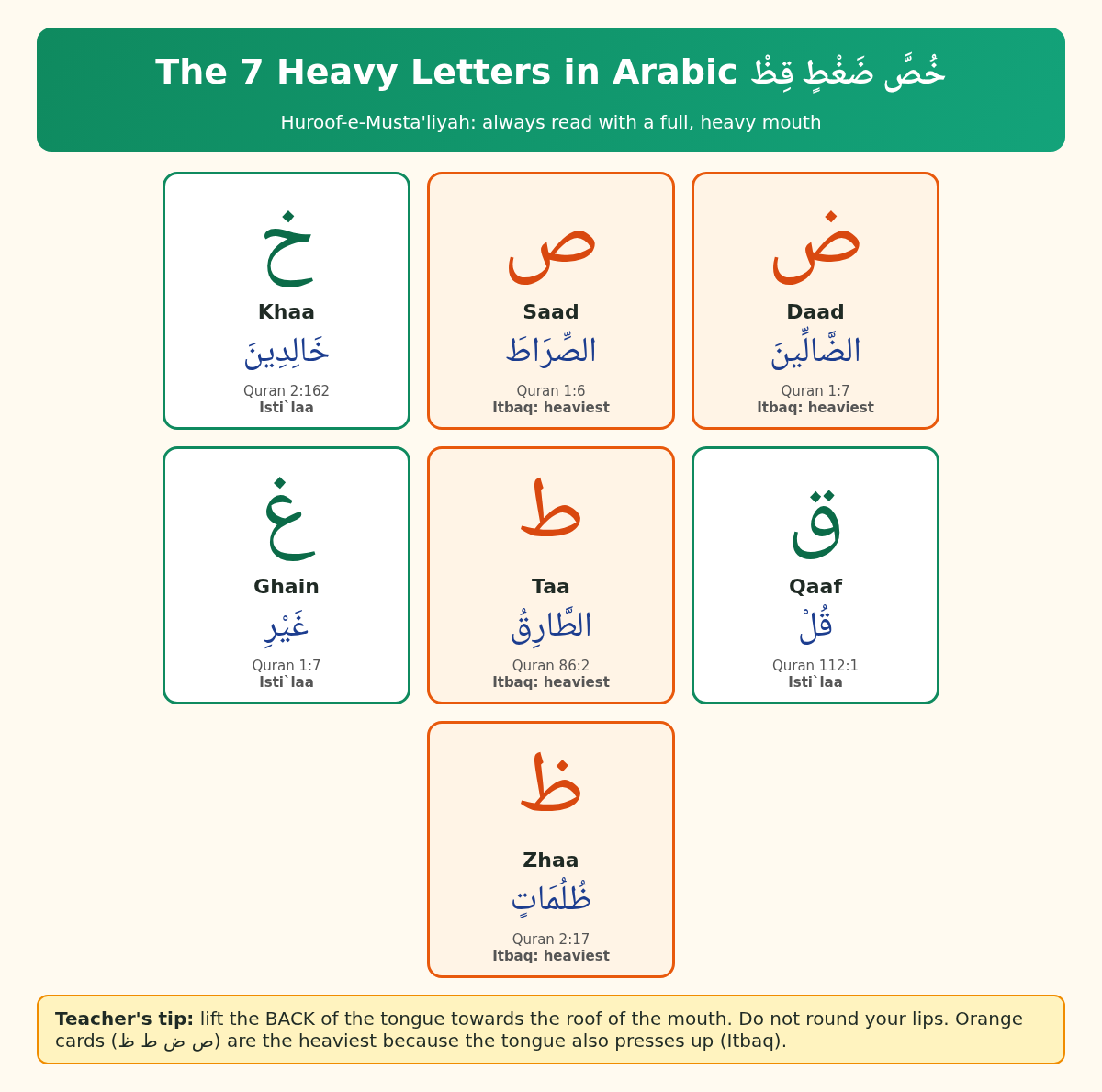
The 7 heavy letters in Arabic (خُصَّ ضَغْطٍ قِظْ) teaching chart with Quran examples
Four of the seven, ص ض ط ظ, are the heaviest. For these, the tongue does not only rise, it also presses up and covers the sound. This is called Itbaq (closing). The other three, خ غ ق, have rising (Isti'laa) without Itbaq.
Letter
Name
Where it is made (Makhraj)
Itbaq?
Quran example
Common mistake
خ
Khaa
Top of the throat (nearest the mouth)
No
خَالِدِينَ(2:162)
Turning it into a "k" or a soft "h"
ص
Saad
Tongue tip near the lower front teeth, with a whistle
Yes
الصِّرَاطَ(1:6)
Saying a thin English "s"
ض
Daad
Side edge of the tongue against the upper molars
Yes
الضَّالِّينَ(1:7)
Turning it into "d", "z" or ظ
غ
Ghain
Top of the throat, with voice
No
غَيْرِ(1:7)
Making it thin like a French "r"
ط
Taa
Tongue tip at the roots of the upper front teeth
Yes
الطَّارِقُ(86:2)
Saying an English "t" with a puff of air
ق
Qaaf
Deepest part of the tongue against the soft palate
No
قُلْ(112:1)
Saying an English "k"
ظ
Zhaa
Tongue tip at the edges of the upper front teeth
Yes
ظُلُمَاتٍ(2:17)
Saying "z" or a thin ذ
How to Pronounce a Heavy Letter: 3 Steps
Find the makhraj first. Say the letter with sukoon after a Hamza, e.g. اَقْ, اَصْ, اَطْ, so you feel exactly where it comes from.
Lift the back of the tongue. The heaviness comes from the back of the tongue rising, so the mouth fills with sound. Keep your lips relaxed. Rounding the lips is a common mistake and turns the Fatha into an "o".
Release only the heavy letter. Drop the tongue again for the next light letter, so the heaviness does not spill onto the letters around it.
The 5 Levels of Heaviness (Maratib-e-Tafkheem)
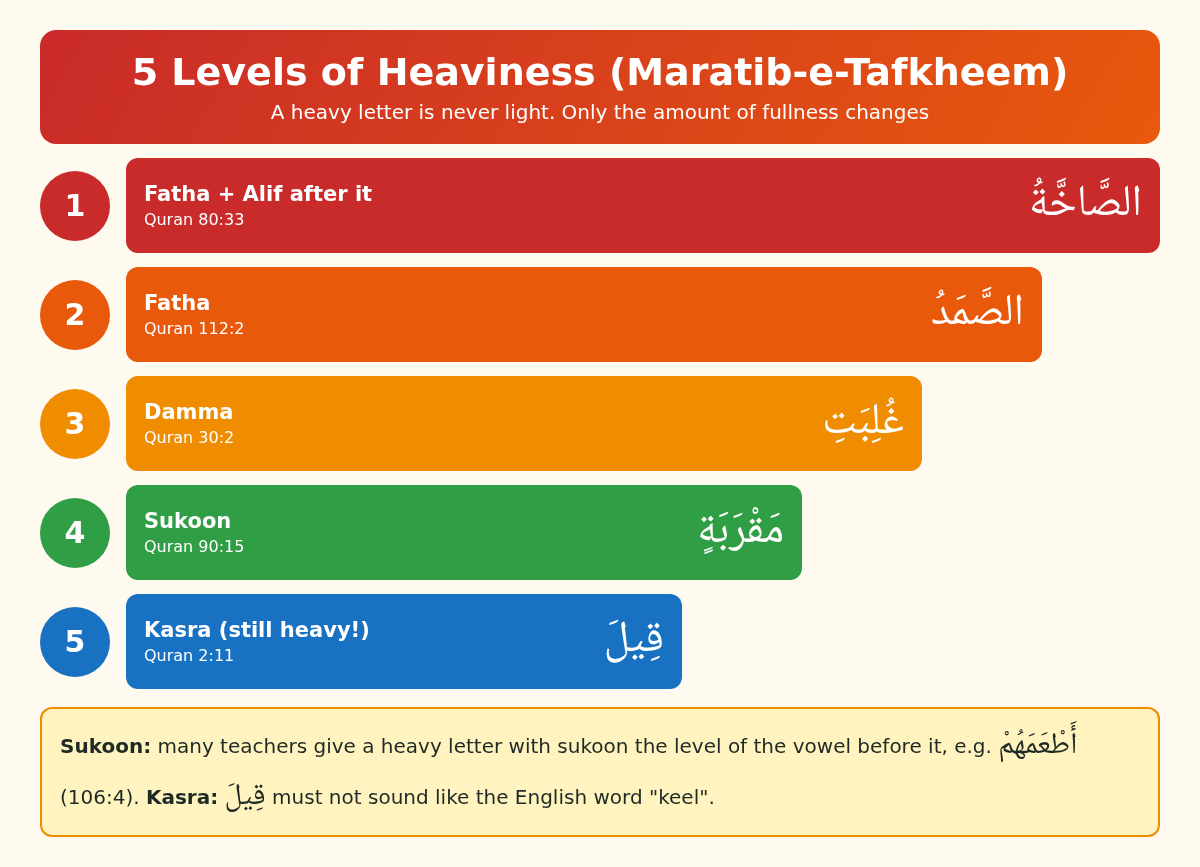
5 levels of heaviness in Tajweed chart: Fatha with Alif, Fatha, Damma, Sukoon, Kasra with Quran examples
A heavy letter is always heavy, but not always equally heavy. Many teachers explain this with five levels, from fullest to least full:
Some teachers use a simpler three-level scheme (by vowel only), and many give a heavy letter with sukoon the level of the vowel before it. Either way, the key point is the same: even at level 5 the letter stays heavy. قِيلَ must not sound like the English word "keel".
Heavy Letters vs Light Letters (Tafkheem and Tarqeeq)
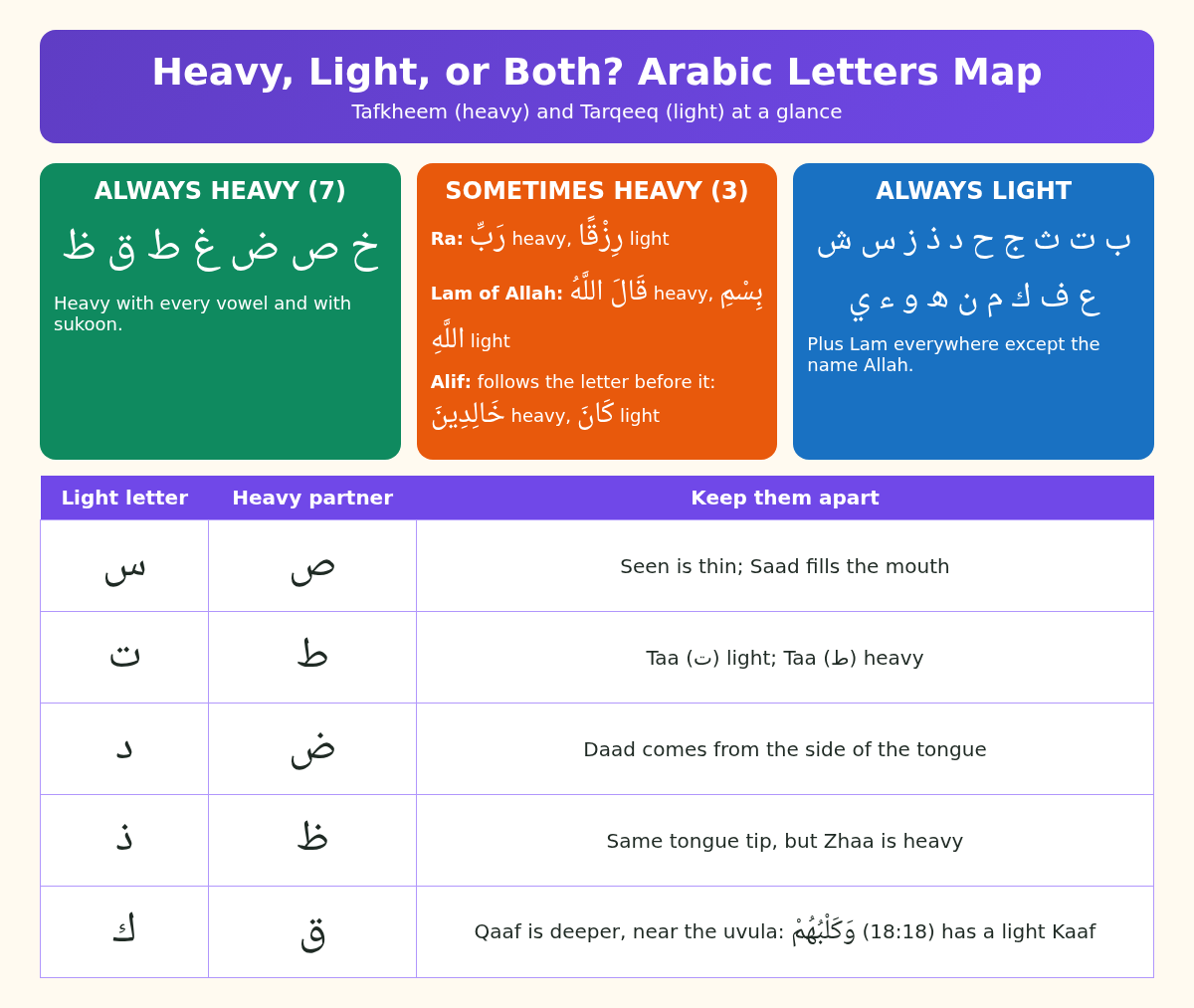
Heavy and light Arabic letters map: 7 always heavy, Ra, Lam of Allah and Alif sometimes heavy, and the always-light letters
The 3 letters that are sometimes heavy
Ra: heavy with Fatha or Damma, e.g. رَبِّ(1:2); light with Kasra, e.g. رِزْقًا(2:22). Full rules with charts: Ra rules in Tajweed.
Lam in the name Allah (Lam-e-Jalalah): heavy after Fatha or Damma, e.g. قَالَ اللَّهُ(3:55) and خَتَمَ اللَّهُ(2:7); light after Kasra, e.g. بِسْمِ اللَّهِ(1:1).
Alif: has no weight of its own; it follows the letter before it. After a heavy letter it is heavy, e.g. خَالِدِينَ(2:162); after a light letter it is light, e.g. كَانَ(4:1).
Light letters that sound close to heavy ones
Each pair below is made in nearly the same place. Swapping them is a clear mistake (Lahn-e-Jali) because it changes the word: س / ص, ت / ط, د / ض, ذ / ظ, ك / ق. For example the Kaaf in وَكَلْبُهُمْ(18:18) stays light, while the Qaaf in قُلْ(112:1) is heavy.
Learn Quran Online with a Qualified Tutor
Join 1-to-1 live Quran classes on Zoom at a time that suits you. Start with 3 Free Trial Classes. No card, no advance payment.
5 Common Mistakes with Heavy Letters (and the Fix)
Rounding the lips. Heaviness comes from the back of the tongue, not the lips. Fix: practise in front of a mirror with relaxed lips.
Making a heavy letter with Kasra light.قِيلَ and الصِّرَاطَ are at the lowest level, but still heavy.
Spilling heaviness onto a light neighbour. In وَلْيَتَلَطَّفْ(18:19) the Taa (ت) next to Taa (ط) stays light, and in الْمُسْتَقِيمَ(1:6) the Seen before the Qaaf stays light.
Turning Qaaf into Kaaf, or Saad into Seen. Fix: drill the pairs in the table above, light then heavy, five times each.
Making Alif heavy after a light letter. Alif only follows the letter before it: كَانَ(4:1) is light.
7-Day Practice Plan (SQA Teaching Method)
Day
What to practise (10 minutes)
1
Learn خُصَّ ضَغْطٍ قِظْ by heart; say each letter with sukoon after a Hamza.
2
Each letter with Fatha, Kasra, Damma, then with Fatha + Alif (level 1).
3
The light/heavy pairs: س ص, ت ط, د ض, ذ ظ, ك ق.
4
Read Surah Al-Fatiha slowly and point out every heavy letter (ص ض غ ط ق).
5
The 5 levels with the Quran words in the table above.
6
Lam of Allah and Alif: heavy or light? Mark them in Surah Al-Ikhlas and Surah An-Nas.
7
Record yourself reciting Juz Amma's short surahs and compare with a teacher or a trusted Qari.