
The letter Ra (ر) is the one letter in Tajweed that changes its sound depending on where it sits. In one word it is read heavy, with a full, deep sound; in the next it is read light, with a thin, clear sound. If you are learning Quran with Tajweed in the USA, UK or Europe, the Ra rules are a key step after the heavy letters and the madd letters. This guide explains when Ra is heavy (tafkheem), when it is light (tarqeeq), what happens when you stop on a Ra, and gives Quranic examples and printable charts you can teach from at home.
What Do Tafkheem and Tarqeeq Mean?
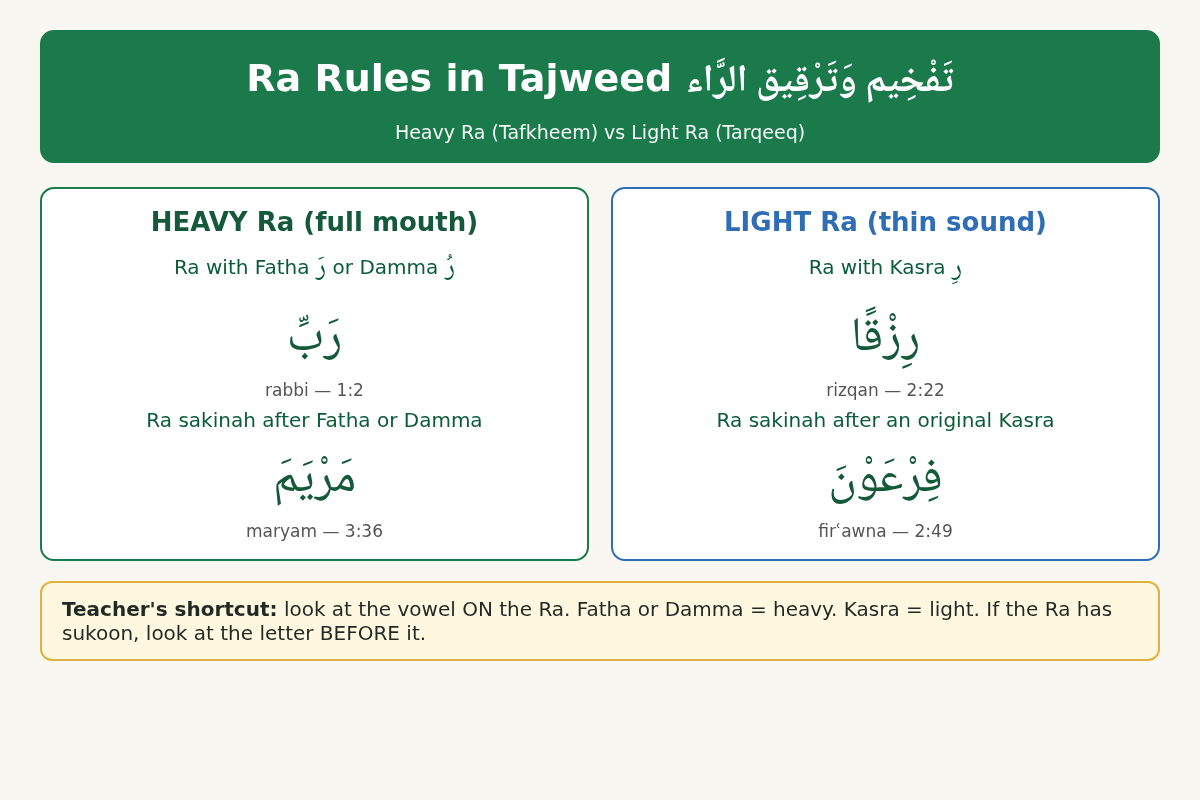
Tafkheem (تَفْخِيم) means making a letter heavy: the back of the tongue rises a little and the sound fills the mouth. Tarqeeq (تَرْقِيق) means making it light: the tongue stays low and the sound is thin and clear.
Seven Arabic letters are always heavy (see our guide to heavy letters in Arabic). Most other letters are always light. Ra is different: it can be heavy or light, and the rules below tell you which. The same is true of the Lam in the word Allah, which has its own rule.
The Quick Rule: Look at the Vowel on the Ra
- Fatha (رَ) or Damma (رُ) on the Ra — read it heavy.
- Kasra (رِ) on the Ra — read it light.
- Sukoon on the Ra (رْ) — look at the letter before it.
A Ra with shaddah follows the same rule: look at its vowel. Most of the time this simple rule is all a beginner needs. The cases below cover the Ra with sukoon and the Ra you stop on.
When Is Ra Heavy (Tafkheem)?
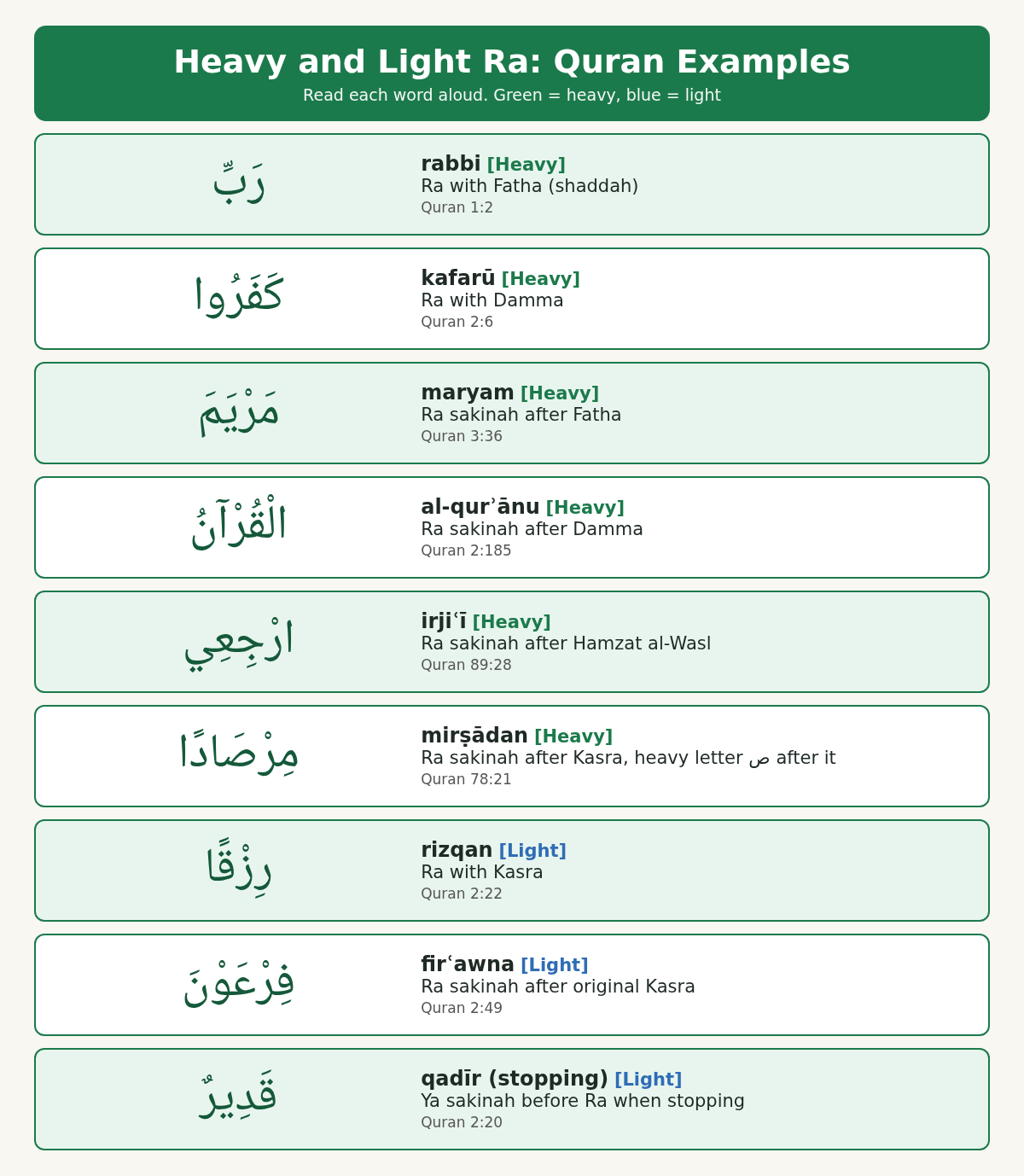
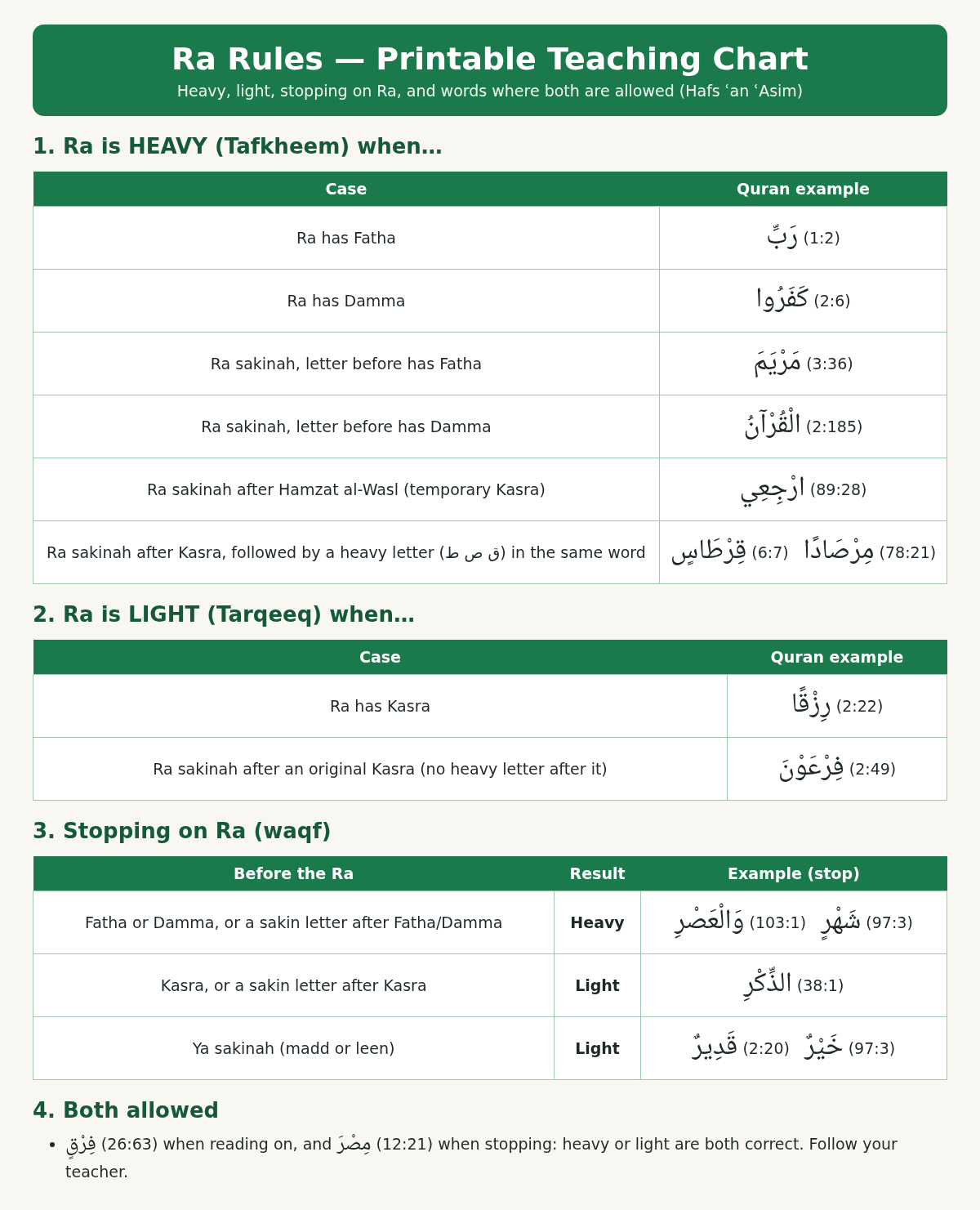
- Ra has a Fatha: رَبِّ — rabbi (Al-Fatihah 1:2)
- Ra has a Damma: كَفَرُوا — kafarū (Al-Baqarah 2:6)
- Ra sakinah after a Fatha: مَرْيَمَ — maryam (Al ʿImran 3:36)
- Ra sakinah after a Damma: الْقُرْآنُ — al-qurʾān (Al-Baqarah 2:185)
- Ra sakinah after Hamzat al-Wasl: the Kasra you say when starting on the hamzah is temporary, so the Ra stays heavy: ارْجِعِي — irjiʿī (Al-Fajr 89:28)
- Ra sakinah after a Kasra, followed by a heavy letter in the same word: قِرْطَاسٍ — qirṭās (Al-Anʿam 6:7) and مِرْصَادًا — mirṣādan (An-Naba 78:21)
When Is Ra Light (Tarqeeq)?
- Ra has a Kasra: رِزْقًا — rizqan (Al-Baqarah 2:22)
- Ra sakinah after an original Kasra (a real Kasra on a letter in the word, with no heavy letter after the Ra): فِرْعَوْنَ — firʿawna (Al-Baqarah 2:49)
Stopping on Ra (Waqf)
When you stop on a word that ends in Ra, the Ra becomes sakin, so you look back at what comes before it:
- Heavy if the letter before has a Fatha or Damma, or is sakin with a Fatha or Damma before it: وَالْعَصْرِ (Al-ʿAsr 103:1) and شَهْرٍ (Al-Qadr 97:3).
- Light if the letter before has a Kasra, or is sakin with a Kasra before it: الذِّكْرِ (Sad 38:1).
- Light if a Ya sakinah comes before the Ra: قَدِيرٌ (Al-Baqarah 2:20) and خَيْرٌ (Al-Qadr 97:3).
Surah Al-Qadr is a good practice lesson: stop on الْقَدْرِ and شَهْرٍ (heavy) and compare them with خَيْرٌ (light), all within a few short ayat.
Words Where Both Are Allowed
In a few words the scholars of Tajweed allow either a heavy or a light Ra in the recitation of Hafs ʿan ʿAsim, for example فِرْقٍ (Ash-Shuʿara 26:63) when reading on, and مِصْرَ (Yusuf 12:21) when stopping. Beginners do not need to worry about these early on; read them the way your teacher reads them.
Video Lesson: Tafkheem and Tarqeeq of Ra
This short video lesson goes through the heavy and light Ra with examples. Watch it once, then practise the chart words above in your own voice.
Common Mistakes with Ra
- Making every Ra heavy — reading رِزْقًا with a full mouth. A Ra with Kasra is always light.
- Making every Ra light — a habit for speakers of English and Urdu. رَبِّ and الْقُرْآنُ need a full, deep Ra.
- Rolling the Ra — Ra is pronounced with one light tap of the tongue; do not trill it, especially with shaddah.
- Forgetting the stopping rule — reading خَيْرٌ heavy when stopping, even though a Ya sakinah comes before it.
- Treating Hamzat al-Wasl as a real Kasra — ارْجِعِي is heavy, not light.
Practice Tips for Home and Class
- Drill in pairs: رَ – رِ, رُ – رِ. Children should hear one heavy and one light sound side by side.
- Read Surah Al-Fatihah and Surah Al-ʿAsr slowly and point to every Ra: say “heavy” or “light” before reading it.
- Practise stopping on Surah Al-Qadr to learn the waqf rule.
- Record yourself and compare with your teacher or a trusted reciter.
Ra rules sit alongside the other letter-based Tajweed lessons. Continue with heavy letters in Arabic, throat letters, qalqalah letters, izhar letters, ikhfa letters and idgham letters. For a structured course with a teacher, visit Learn Tajweed.

Learn Quran Online with a Qualified Tutor
Join 1-to-1 live Quran classes on Zoom at a time that suits you. Start with 3 Free Trial Classes. No card, no advance payment.
- 1-to-1 classes on Zoom
- Available 24/7
- Male & female tutors
- For kids & adults
Classes by country: Online Quran Academy in USA · Online Quran Classes Canada · Online Quran Classes UK · Online Quran Classes for Kids & Adults
Families who want live correction can join 1-to-1 Zoom classes: see online Quran courses for kids, online Quran classes for ladies, or online Quran classes in the USA.
Quick Reference: Ra Rules
Heavy: Ra with Fatha or Damma · Ra sakinah after Fatha or Damma · after Hamzat al-Wasl · after Kasra with a heavy letter after it
Light: Ra with Kasra · Ra sakinah after an original Kasra
Stopping: look back; Fatha/Damma = heavy, Kasra or Ya sakinah = light
Frequently Asked Questions
When is Ra heavy in Tajweed?
Ra is heavy when it has a Fatha or Damma, when it is sakin after a Fatha or Damma, when it is sakin after Hamzat al-Wasl, and when it is sakin after a Kasra with a heavy letter right after it in the same word.
When is Ra light in Tajweed?
Ra is light when it has a Kasra, and when it is sakin after an original Kasra with no heavy letter after it, as in فِرْعَوْنَ.
Is Ra one of the heavy letters?
Not always. The seven always-heavy letters are خ ص ض غ ط ق ظ. Ra is sometimes heavy and sometimes light depending on its vowel and the letter before it.
What happens to Ra when stopping?
When you stop, Ra becomes sakin. If the letter before it (or before a sakin letter) has a Fatha or Damma, it is heavy; if it has a Kasra, or a Ya sakinah comes before the Ra, it is light.
Why is the Ra in ارْجِعِي heavy if there is a Kasra before it?
The Kasra is on Hamzat al-Wasl, which is only pronounced when you start on that word. It is not an original Kasra, so the Ra stays heavy.
When do children learn the Ra rules?
Usually after they can read with Fatha, Kasra, Damma and sukoon in the Noorani or Madani Qaida, and after learning the heavy letters.
Practise Heavy and Light Ra with a Teacher — 3 Free Trial Classes
No card needed • Live 1-to-1 on Zoom, 24/7 • Male and female teachers
Plans: 20 classes/month, 30 min each — $45 / $40 / $35
WhatsApp us: +1 (380) 206-9388
Contact us or book your free trial with the form below.
Learn Quran Online with a Qualified Tutor
Join 1-to-1 live Quran classes on Zoom at a time that suits you. Start with 3 Free Trial Classes. No card, no advance payment.
- 1-to-1 classes on Zoom
- Available 24/7
- Male & female tutors
- For kids & adults
Classes by country: Online Quran Academy in USA · Online Quran Classes Canada · Online Quran Classes UK · Online Quran Classes for Kids & Adults
