
If you are learning to read the Quran with Tajweed in the USA, UK or Europe, the madd letters are among the first rules you will meet in your Qaida. They decide when a sound is short and when it is stretched. Get them right and your recitation sounds smooth and correct; get them wrong and short vowels turn long (or long vowels turn short), which can change the meaning of a word. This guide explains the three madd letters, shows exactly when each one becomes a madd, gives Quranic examples you can practise at home, and includes printable charts you can teach from.
What Is Madd in Tajweed?
Madd (مَدّ) means “to stretch” or “to lengthen.” In Tajweed, it means lengthening the sound of a vowel using one of the three madd letters (حُرُوفُ الْمَدِّ, huroof al-madd). Short vowels (Fatha, Kasra, Damma) take one count. When a madd letter follows the right short vowel, the sound is stretched — at least two counts.
A “count” (harakah) is roughly the time it takes to say one short vowel at your normal reading pace. It is a relative measure: keep it even through your recitation rather than timing it with a clock.
What Are the 3 Madd Letters?
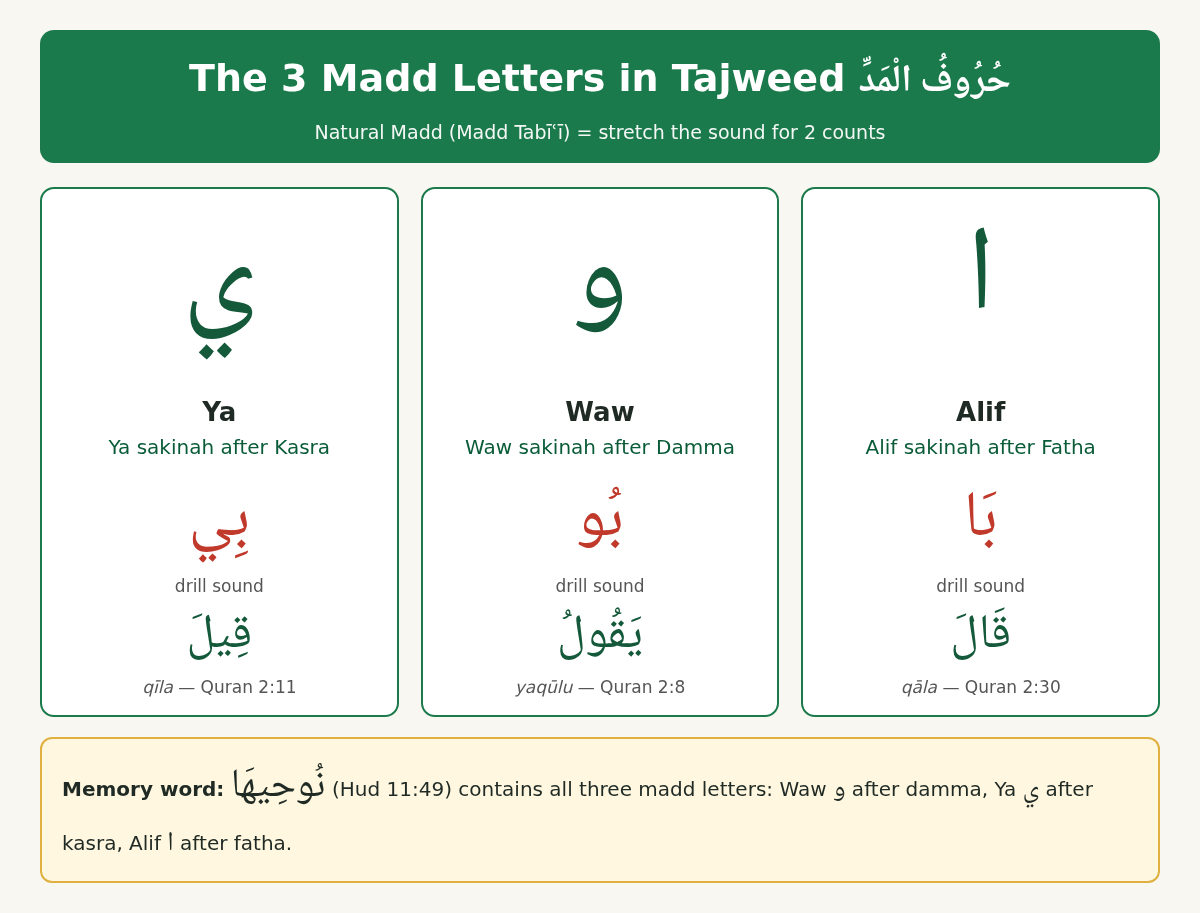
There are exactly three madd letters. Each one is a madd letter only when it has no vowel of its own (sakin) and the letter before it carries the matching short vowel:
| Letter | Name | Condition | Drill sound | Quran example |
|---|---|---|---|---|
| ا | Alif | Alif sakinah, letter before has Fatha | بَا (bā) | قَالَ — qāla (Al-Baqarah 2:30) |
| و | Waw | Waw sakinah, letter before has Damma | بُو (bū) | يَقُولُ — yaqūlu (Al-Baqarah 2:8) |
| ي | Ya | Ya sakinah, letter before has Kasra | بِي (bī) | قِيلَ — qīla (Al-Baqarah 2:11) |
A simple way to remember: Fatha goes with Alif, Damma goes with Waw, Kasra goes with Ya. Alif is always sakin and always preceded by Fatha, so every plain Alif that you read in a word is a madd letter. Waw and Ya need checking — they can also be ordinary consonants (as in وَعَدَ or يَدٌ), where they carry their own vowel and are not stretched.
Many teachers use the Quranic word نُوحِيهَا (Hud 11:49) as a memory aid, because it contains all three: Waw after Damma (نُو), Ya after Kasra (حِي), and Alif after Fatha (هَا).
Natural Madd (Madd Tabīʿī): The 2-Count Rule
When a madd letter is not followed by a hamzah (ء) or a sukoon, it is called Madd Tabīʿī (natural madd) or Madd Aslī (original madd). You stretch it for exactly two counts — not one, and not three or more.
- Find the madd letter (ا, و or ي without a vowel).
- Check the vowel on the letter before it: Fatha for Alif, Damma for Waw, Kasra for Ya.
- Check what comes after: if there is no hamzah and no sukoon, it is natural madd.
- Stretch the vowel smoothly for two even counts, then move on.
The sound of a madd letter comes from the open space of the mouth and throat (al-jawf), so keep the mouth open and the sound steady — do not press the tongue or add a small hamzah at the end.
Madd Letter Examples from the Quran
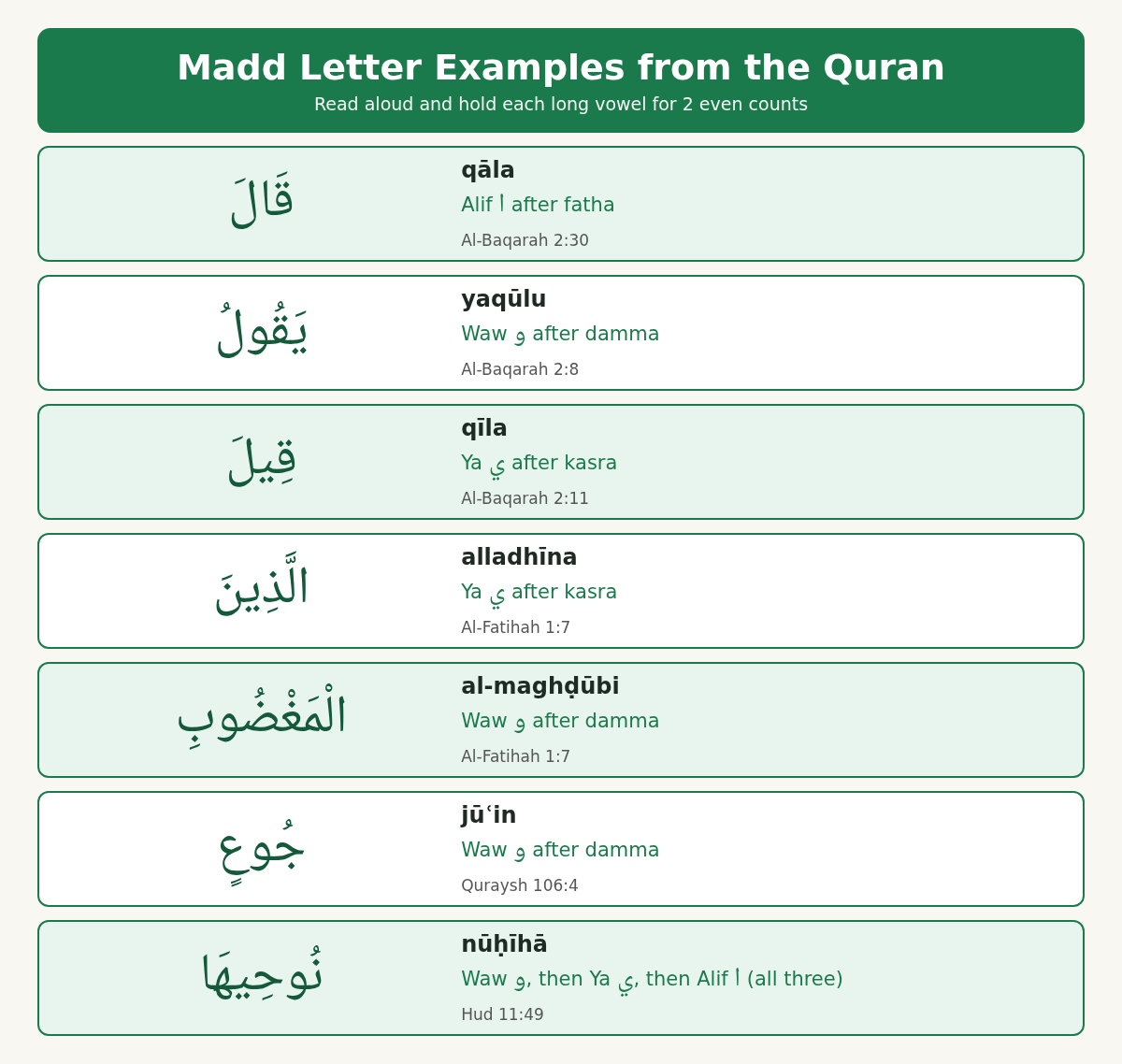
Read these words aloud, stretching each long vowel for two counts. Every example below was checked against the Quran text with its surah and ayah reference:
- قَالَ — qāla — Alif after Fatha — Al-Baqarah 2:30
- يَقُولُ — yaqūlu — Waw after Damma — Al-Baqarah 2:8
- قِيلَ — qīla — Ya after Kasra — Al-Baqarah 2:11
- الَّذِينَ — alladhīna — Ya after Kasra — Al-Fatihah 1:7
- الْمَغْضُوبِ — al-maghḍūbi — Waw after Damma — Al-Fatihah 1:7
- جُوعٍ — jūʿin — Waw after Damma — Quraysh 106:4
- نُوحِيهَا — nūḥīhā — all three madd letters — Hud 11:49
Madd Letters vs Leen Letters
Students often confuse the madd letters with the leen (soft) letters. Leen happens when Waw or Ya is sakin but the letter before it has a Fatha instead of the matching vowel:
- خَوْفٍ — khawfin — Waw sakinah after Fatha — Quraysh 106:4
- الْبَيْتِ — al-bayti — Ya sakinah after Fatha — Quraysh 106:3
When you read through these words without stopping, leen letters are read softly at normal length — they are not stretched like natural madd. They are lengthened (2, 4 or 6 counts) only when you stop on the word, for example at the end of an ayah. Surah Quraysh is a handy lesson because the madd word جُوعٍ and the leen word خَوْفٍ sit in the same ayah.
Main Types of Madd at a Glance
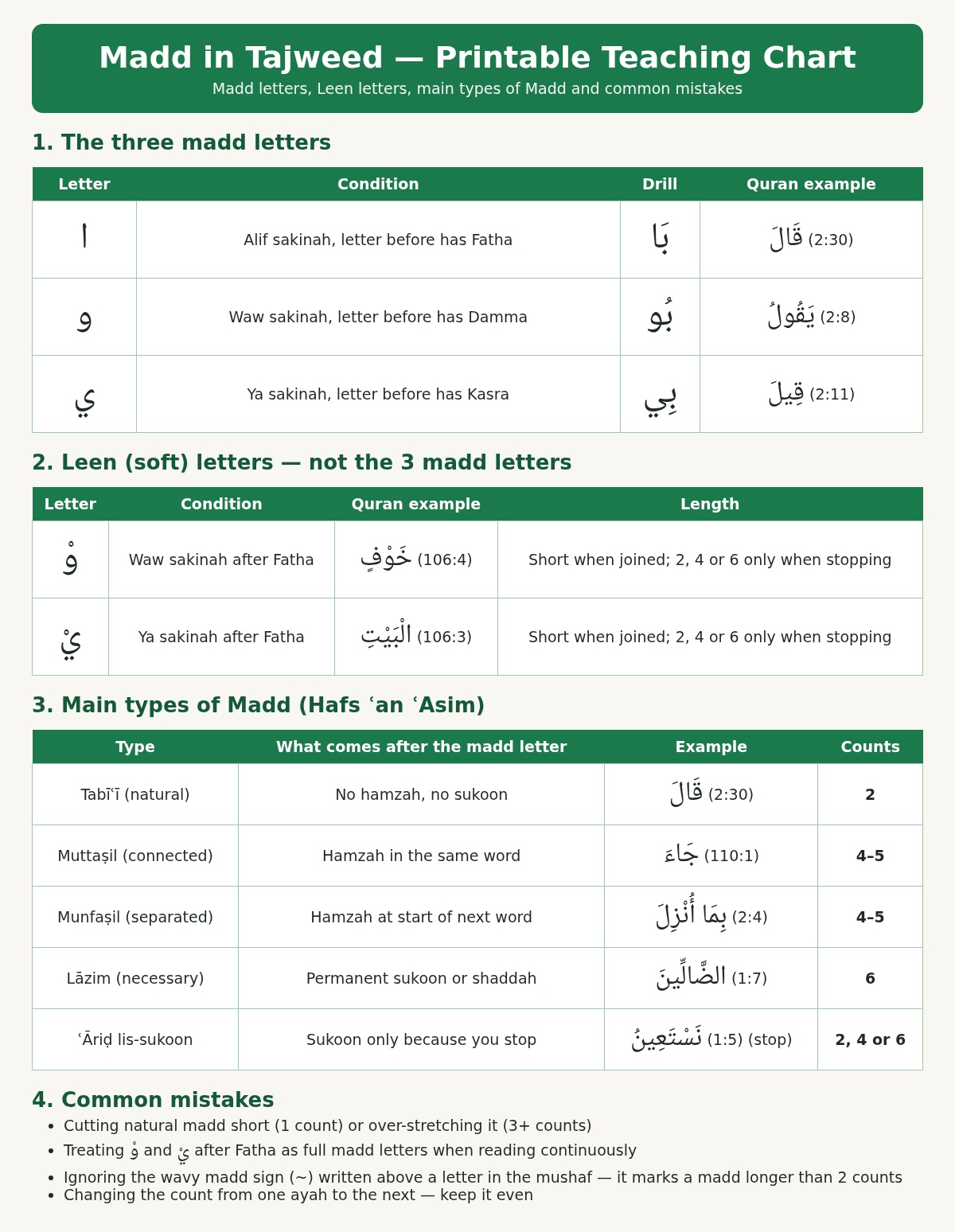
Natural madd is the base. When a hamzah or a sukoon comes after the madd letter, the madd becomes a “secondary” (farʿī) madd and is stretched longer. The counts below are the ones commonly taught for the recitation of Hafs ʿan ʿAsim; your teacher will set one length and ask you to keep it consistent.

Learn Quran Online with a Qualified Tutor
Join 1-to-1 live Quran classes on Zoom at a time that suits you. Start with 3 Free Trial Classes. No card, no advance payment.
- 1-to-1 classes on Zoom
- Available 24/7
- Male & female tutors
- For kids & adults
Classes by country: Online Quran Academy in USA · Online Quran Classes Canada · Online Quran Classes UK · Online Quran Classes for Kids & Adults
| Type | What comes after the madd letter | Example | Counts |
|---|---|---|---|
| Madd Tabīʿī (natural) | No hamzah, no sukoon | قَالَ (2:30) | 2 |
| Madd Muttaṣil (connected) | Hamzah in the same word | جَاءَ (An-Nasr 110:1) | 4–5 |
| Madd Munfaṣil (separated) | Hamzah at the start of the next word | بِمَا أُنْزِلَ (Al-Baqarah 2:4) | 4–5 |
| Madd Lāzim (necessary) | Permanent sukoon or shaddah | الضَّالِّينَ (Al-Fatihah 1:7) | 6 |
| Madd ʿĀriḍ lis-Sukoon | Sukoon only because you stop | نَسْتَعِينُ when stopping (Al-Fatihah 1:5) | 2, 4 or 6 |
In most printed mushafs, a small wavy line (the madd sign) is written above a madd letter when it must be stretched longer than two counts. If you see that sign, it is not natural madd — look at what follows (hamzah or sukoon) to know which type it is.
Video Lesson: Natural Madd
If you learn better by listening, this short video lesson walks through natural madd (Madd Tabīʿī) with examples. Watch it once, then practise the chart words above in your own voice.
Common Mistakes with Madd Letters
- Cutting natural madd short — reading قَالَ like “qala” with a short a. The long vowel is part of the word.
- Over-stretching natural madd — holding it for three or four counts when nothing after it calls for a longer madd.
- Stretching short vowels — adding a long sound where there is no madd letter (for example, reading a single Fatha as “aa”).
- Treating leen as madd — stretching خَوْفٍ or الْبَيْتِ while reading continuously.
- Uneven counts — using two counts in one ayah and four in the next for the same type of madd.
- Ignoring the madd sign — reading a wavy-line madd as if it were natural madd.
Practice Tips for Home and Class
- Start with the Qaida drill: بَا – بُو – بِي, then repeat with other letters (تَا – تُو – تِي, and so on).
- Tap two fingers as you stretch each madd so children can feel the two counts.
- Read Surah Al-Fatihah slowly and point to every madd letter — it contains natural madd, a necessary madd (الضَّالِّينَ) and stopping madd at the end of the ayat.
- Use Surah Quraysh to hear the difference between madd (جُوعٍ) and leen (خَوْفٍ).
- Record yourself and listen: are the long vowels clearly longer than the short ones, and are they all the same length?
Madd sits right next to the other letter-based Tajweed rules. If you are building a full lesson plan, continue with heavy letters in Arabic, throat letters, izhar letters, qalqalah letters, ikhfa letters and idgham letters. For a structured course with a teacher, visit Learn Tajweed.
Families who want live correction can join 1-to-1 Zoom classes — see online Quran courses for kids, online Quran classes for ladies, or online Quran classes in the USA.
Quick Reference: Madd Letters
Letters: ا و ي
Condition: Alif after Fatha · Waw sakinah after Damma · Ya sakinah after Kasra
Natural madd: 2 counts when no hamzah or sukoon follows
Longer madd: hamzah or sukoon after the madd letter (look for the wavy madd sign)
Not madd: Waw or Ya with their own vowel; Waw/Ya sakinah after Fatha (leen)
Frequently Asked Questions
What are the madd letters in Tajweed?
There are three: Alif (ا) after Fatha, Waw sakinah (و) after Damma, and Ya sakinah (ي) after Kasra. They are called huroof al-madd.
How many counts is natural madd?
Two counts. Natural madd (Madd Tabīʿī) is stretched for two even counts when no hamzah or sukoon comes after the madd letter.
Is every Waw and Ya a madd letter?
No. Waw and Ya are madd letters only when they are sakin and the letter before has the matching vowel (Damma for Waw, Kasra for Ya). If they carry their own vowel, they are normal consonants; if they are sakin after a Fatha, they are leen letters.
What is the difference between madd and leen letters?
Madd letters follow their matching vowel and are always stretched. Leen letters are Waw or Ya sakinah after a Fatha (as in خَوْفٍ and الْبَيْتِ); they are read softly at normal length and lengthened only when you stop on the word.
Which word contains all three madd letters?
نُوحِيهَا (Hud 11:49) is a common teaching example: Waw after Damma, Ya after Kasra, and Alif after Fatha in one word.
Why do some madd letters have a wavy line above them?
The wavy madd sign tells the reader to stretch longer than natural madd, usually because a hamzah or sukoon follows. Your teacher will show you the correct count for each case.
At what age can children learn madd letters?
Children usually learn madd letters in the Noorani or Madani Qaida, right after they can read letters with Fatha, Kasra and Damma. The drill بَا – بُو – بِي is often their first madd lesson.
Practise Madd with a Teacher — 3 Free Trial Classes
No card needed • Live 1-to-1 on Zoom, 24/7 • Male and female teachers
Plans: 20 classes/month, 30 min each — $45 / $40 / $35
WhatsApp us: +1 (380) 206-9388
Contact us or book your free trial with the form below.
Learn Quran Online with a Qualified Tutor
Join 1-to-1 live Quran classes on Zoom at a time that suits you. Start with 3 Free Trial Classes. No card, no advance payment.
- 1-to-1 classes on Zoom
- Available 24/7
- Male & female tutors
- For kids & adults
Classes by country: Online Quran Academy in USA · Online Quran Classes Canada · Online Quran Classes UK · Online Quran Classes for Kids & Adults
