
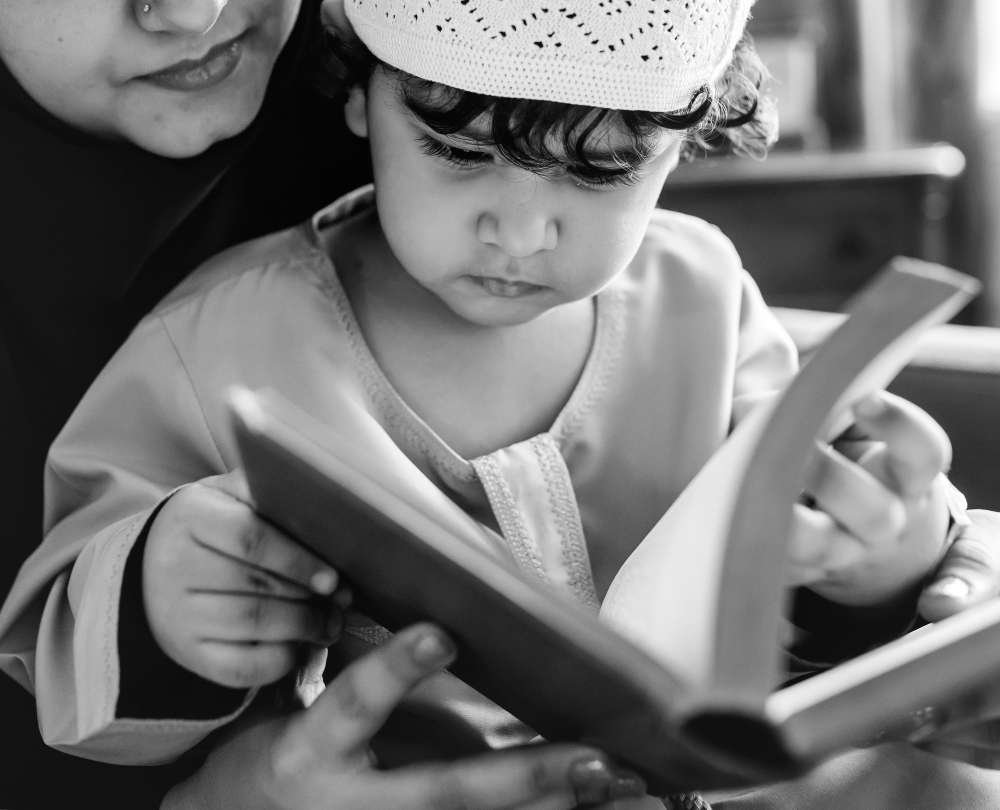
When introducing the Quran to children, it’s about more than just reciting the words in Arabic or simply memorizing verses. It’s about planting a seed, one that has the potential to grow into faith, character, resilience, and a strong moral compass. Kids are, by nature, curious and open-minded, and impressionable. What they digest during their early years can also serve as a lens through which they view the world. When presented with compassion and wisdom, the Quran is transformed from a book into a lifelong friend.
The Quran is addressing the soul of mankind, and children with their innocent hearts are the most open to it. Even if they don’t grasp every word at the outset, the rhythm, tone, and message start to form their inner landscape. It’s similar to learning a language by immersion.
Quran and the Formation of Values, Morality, and Character
The Quran emphasizes honesty, good behavior, patience, gratitude, and empathy, qualities that every parent would want their child to carry into adulthood. Get these values in there early, and they don’t feel shoehorned into the process somewhere down the line. Instead, they become instinctive. A child who listens to accounts of the mercy of Prophet Muhammad or the patience of Prophet Yusuf develops a moral imagination, rather than hearing about morality in sermons.
What sets the Quran apart is that it doesn’t simply tell children what to do; it shows them why. But as children grow older, they are trained to view good behaviour not in terms of fear of punishment but by the expectation of a spiritual reward. That shift is powerful. It makes belief something they want to welcome, not something in which they fear that they are ensnared.
Early spiritual exposure and lasting impact
This early spiritual exposure works in much the same way as physical training; it builds up strength over time. When a child is taught the Quran at an early age, they tend to grow up having more identity and emotional strength. The Quran is a beloved anchor when life gets confusing, as it invariably does.
Research and real-life experiences demonstrate why children who are reared with spiritual grounding cope better with stress, adversity, and hardship. They come to understand that life means more than just material success. That’s not to say they won’t doubt or struggle later on. But it does mean they’ll have an anchor, a place to go back to when they’re looking for something meaningful.
At What Age Should Kids Start Reading the Quran?
One of the most frequent questions that parents ask is, “When can I start teaching my child the Quran?” The short, truthful answer: There is no one “perfect” age. Every child is different. The issue is approach, not timing. Introducing the Quran does not mean taking up formal lessons immediately. It can start softly, organically, and even with theoretical ease.
The training of a child begins the very second they are born. They know the sound of your voice, sounds from your home, and the patterns in their day, long before they can understand words. “Right from the very beginning, I don’t see why the Quran can’t be part of that environment, even just playing quietly in the background.”
Early Childhood – Planting the Seeds
Young forces are like sponges in the toddler and preschool years. This is a perfect time to share with their hearts and souls the sound of the Quran. Reciting recitations, teaching small duas, or reading short surahs together before bed forms a good habit for children.
Don’t worry about, tajweed rules, or memorization goals at this stage. The goal is to get used to it. When a child listens to the Quran & they feel safe, loved, and comfortable in listening to the Quran, their brain wires good emotions from the Book of Allah. That emotional connection is what will count far more than technical correctness down the line.
School Age – Building Understanding and Connection
As our children grow, so does their ability to gain some concept. This is a good time to introduce simple meanings, stories, and basic recitation. It would seem that children aged six to ten are most adept at this. Quranic stories of the prophets are bedtime tales one can tell kids with great lessons, adversity, and hope.
This stage is also great for learning the Arabic Alphabet or small surahs by rote. However, flexibility is key. Some children do better with routine, others need variety. It’s not about speed; it’s about rhythm.
Pre-Adolescence and Adolescence – Developing Introspection
Once kids enter preteen and teen years, they start asking questions about faith, purpose, and identity that are more intense. If the Quran has been a part of their existence from an early age, these are natural conversations and not forced ones.
It is at this point that reflection matters. Promoting the practice of children reflecting on how something from the Quran can be applied to their real-life experiences, such as friendships, peer pressure, and emotions, helps make sure they are seeing it as relevant and living. Instead of being “just a religious book,” it becomes a how-to they can actually follow.
Preparing Yourself as a Parent or Educator
Before you introduce the Quran to children, there’s an important step of tapping into looking inward. Children don’t simply learn from what we say, but from who we are. When we ourselves carry the Quran as a burden, children pick up on that. If what feels like a source of peace is something they’ll feel too.
You do not have to be a scholar or a good, perfect Muslim to teach the Quran. What you need is sincerity. Kids love real more than perfect.
First Role Model
Children imitate what they see. If they see you reciting the Quran, thinking about it, perhaps even wrestling with it honestly and vigorously, like any other part of your life, not something that belongs to experts, this shows them that the Quran is part of real life. It is also incredibly powerful to sit down with your child and learn together. It sends a message: we are on this journey together.
Even the simplest of actions, such as leaving the Quran in a clean, respected manner or reciting a single verse after prayer, have lifelong effects. These little things subtly teach a child reverence and love.
Establishing the Mindset and Intentions
Your intention matters. Teaching the Quran isn’t a matter of comparison, competition, or social pressure. What this is not about: The goal isn’t to raise a child who can impress others by memorization. It’s raising a child who finds solace, guidance, and strength from Allah’s Words.
When you teach with the intention, it becomes gentler. You’re more patient. You listen more. And children feel that. They know when learning is coming from love and not expectations.
Providing a Quran-Friendly Environment at Home
A child’s learning environment has a huge impact on their perception of learning. When mastering the Quran feels like a punishment or an intrusion on “fun time,” resistance is natural.
Physical Space and Emotional Atmosphere
You don’t need a special prayer room or fancy arrangement. Anything that affords you some peace: a hidden corner, space on a shelf to put the Qur’an, or a simple place to sit with each other works. It’s the emotional climate that counts most of all. Is the environment calm? Is the child relaxed? Is there warmth and encouragement?
Introducing the Quran as an Organic Part of Everyday Life
The Quran doesn’t have to be confined to a specified “study time.” You can recite a brief verse before you leave the house, discuss a Quranic lesson during a car ride, or reflect on a verse when something associated is taking place in daily life.
When your child shares a toy, use that as an opportunity to gently relate that action to the teachings of the Quran about kindness and generosity, for instance. These small connections help kids to view the Quran as something that’s practical and relevant, not far off or abstract.
Selecting the Appropriate Quran Resources for Kids
Choosing the right tools for the job can make or break a child’s connection to the Quran. Children do not learn like adults. Excessive text, complicated explanations , and rigid formats can kill curiosity in a heartbeat. The trick, of course, is to find the right resources for a child’s age, learning style, and emotional maturity. It doesn’t feel like studying when the right tools are utilized to learn the Qur;n, rather, it feels like exploring something fascinating.
Child-Friendly Qurans and Translations
A children’s Quraan typically emphasizes the level of clarity, simplicity, and fun visually. Large fonts, colorful borders, and clear Arabic text make the younger children less intimidated. Simplified translations that are written in a language tailored to their ages can be invaluable for children who do not yet know Arabic.
Instead of the word-for-word literal translations, seek out translations that interpret meanings gently. For instance, verses that speak about Allah’s mercy, creation, or kindness can be understood and emotionally related to by children. It should feel conversational, not didactic.
Story-Based Tafsir and Illustrated Books
They’ll thank you for encouraging them to do so, he says Children love stories it’s the way they process a world that often makes no sense. Narrative tafsir books of verses of the Holy Quran in story form are wonderful ways to tell people about the interpretation. Such books usually deal with the life stories of prophets and Sahaba or carry moral teachings derived from Quranic verses.
Illustrated books provide one more dimension of interaction. Visual storytelling enables children to remember lessons longer and comprehend abstract concepts more readily. The story of Nuh (a) comes to life for children when they can see pictures of the ark, the animals, and the storm.
Digital Tools, AP, PS Audio resources
In this digital age, however, eliminating screens isn’t feasible. Instead, use technology wisely. Quran applications for children typically feature games, quizzes, and audio recitation, which creates an interactive learning experience.
Audio resources are especially powerful. It can be used as a way for children to listen to beautiful recitations , practice, chill, or go to sleep. Eventually, they will start memorizing verses voluntarily with ease. Select those reciters whose pronunciations are clear and calm.
Conclusion
Introducing the Quran is a journey, not an end. It takes patience, love, and consistency. When performed with sincerity, the Quran becomes a lifelong companion: it has the power to guide, console, and inflame hearts. Whatever you are sowing today will blossom for a lifetime.
FAQs
How much Quran should children read?
For long, irregular days are not as good as small daily ones.
What if my child just doesn’t want to learn the Quran?
Stop, re-evaluate how you’re doing things, and connect vs complete.
Do you need to remember when we were young?
It’s useful but should never be mandatory.
Can non-Arabic-speaking parents teach the Quran?
Absolutely. Learning together is powerful.
How can I ensure my child has long-term motivation?
Love and edification (and relevancy) change everything.
