
Idgham Letters in Tajweed: The 6 Letters of Merging Noon Sakinah
If you are learning Quran recitation with Tajweed in the USA, UK or Europe, you will meet the word Idgham soon after learning the Arabic letters. Students often remember Izhar (clear Noon) and then get confused when the Noon sound suddenly disappears into the next letter. This guide lists all idgham letters, explains when to use gunnah, shows Quranic examples you can practise at home, and links Idgham to the other Noon Sakinah rules.
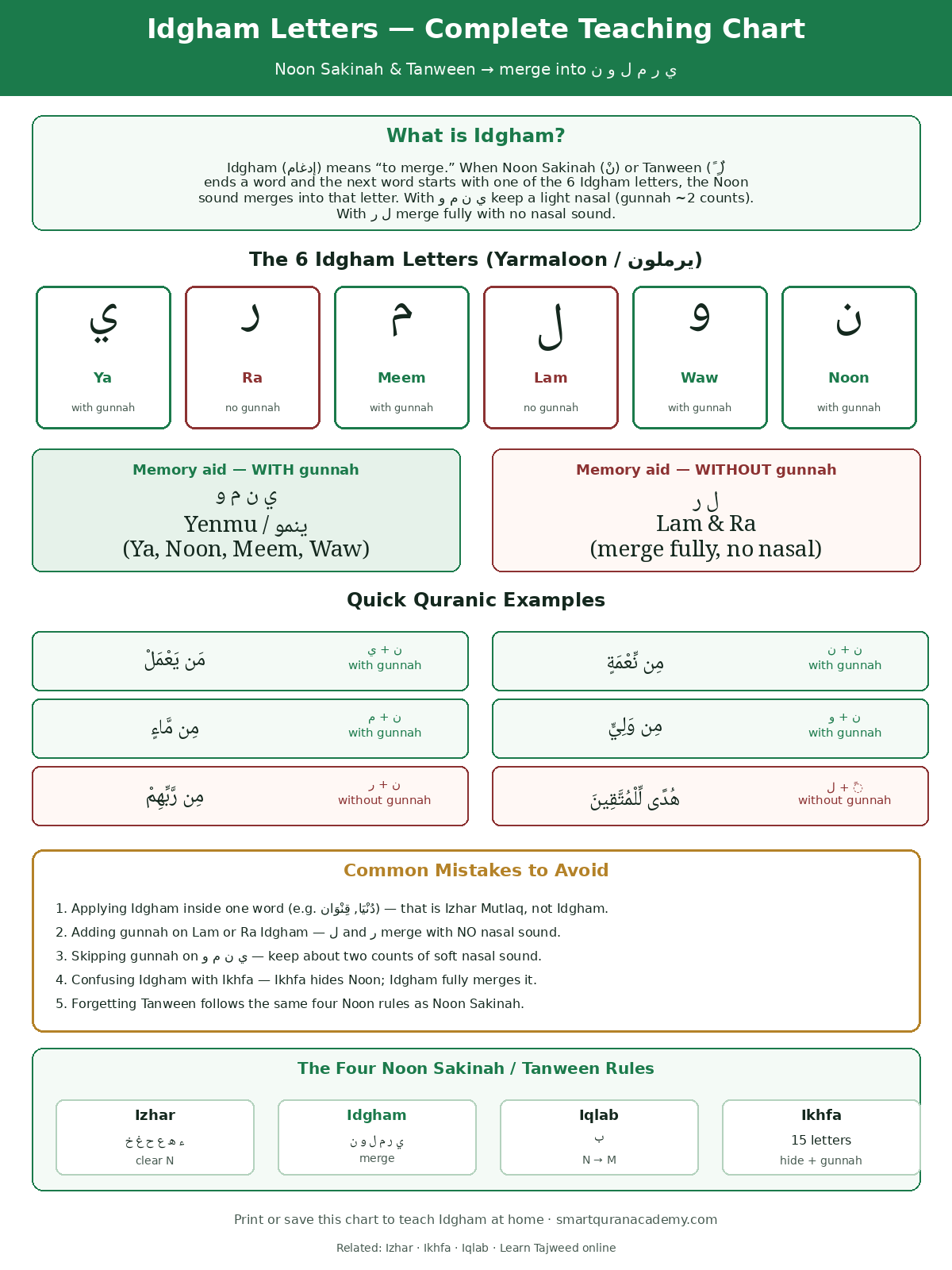
What Does Idgham Mean in Tajweed?
Idgham (إدغام) in Arabic means “to merge” or “to insert.” In Tajweed, it is the rule applied when a Noon Sakinah (نْ) or a Tanween (ً ٍ ٌ) at the end of a word is followed by one of six specific letters at the start of the next word. Instead of saying a clear “n” sound, you merge the Noon into that next letter.
Think of the four Noon Sakinah / Tanween rules as a family:
- Izhar — clear Noon (throat letters)
- Idgham — merge Noon into the next letter (the six letters below)
- Iqlab — change Noon into a Meem sound before ب
- Ikhfa — hide Noon with a light nasal sound before the fifteen ikhfa letters
Idgham is the “merge” rule. Once you can hear the difference between a clear Noon and a merged Noon, the rest of the family becomes much easier.
What Are the Idgham Letters?
There are six idgham letters. Teachers remember them with the word يرملون (Yarmaloon):
| Arabic | Name | Transliteration | Ghunnah? |
|---|---|---|---|
| ي | Ya | Yā | Yes — with gunnah |
| ر | Ra | Rā | No — without gunnah |
| م | Meem | Mīm | Yes — with gunnah |
| ل | Lam | Lām | No — without gunnah |
| و | Waw | Wāw | Yes — with gunnah |
| ن | Noon | Nūn | Yes — with gunnah |
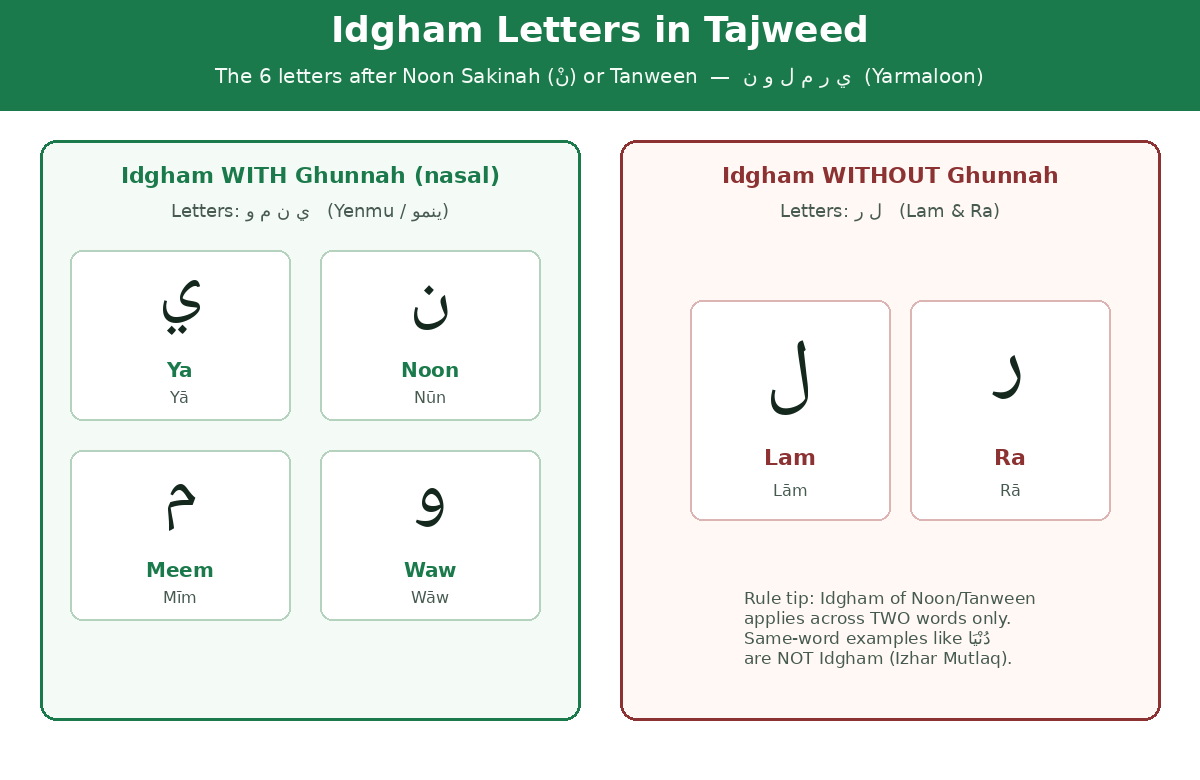
Idgham With Ghunnah (Yenmu / ينمو)
Four of the six letters take Idgham with a nasal sound (gunnah). The memory word is ينمو (Yenmu):
- ي — Ya
- ن — Noon
- م — Meem
- و — Waw
When Noon Sakinah or Tanween meets one of these letters across two words, merge the Noon into that letter and hold a soft nasal sound for about two counts. You should not hear a full, separate “n” before the next letter.
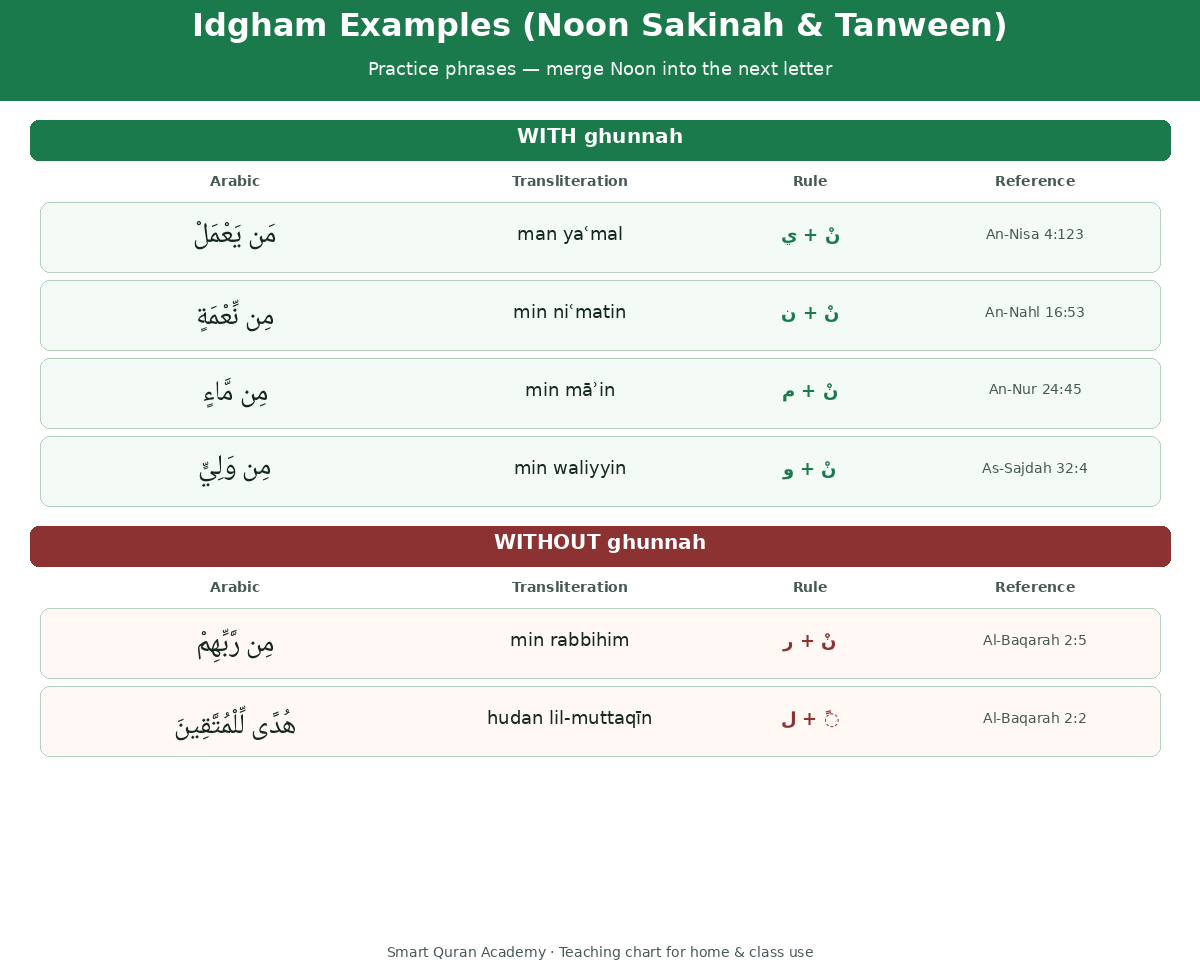
Examples with ghunnah
- مَن يَعْمَلْ — man yaʿmal (نْ + ي) — An-Nisa 4:123
- مِن نِّعْمَةٍ — min niʿmatin (نْ + ن) — An-Nahl 16:53
- مِن مَّاءٍ — min māʾin (نْ + م) — An-Nur 24:45
- مِن وَلِيٍّ — min waliyyin (نْ + و) — As-Sajdah 32:4
In each case the Noon of the first word is not recited as a clear “n”; it merges into Ya, Noon, Meem or Waw with a light nasal tone.
Idgham Without Ghunnah (Lam & Ra)
The remaining two letters take Idgham without gunnah:
- ل — Lam
- ر — Ra
Here the Noon merges completely into Lam or Ra. There is no nasal hold. If you add gunnah on Lam or Ra Idgham, the recitation sounds incorrect to a trained ear.
Examples without ghunnah
- مِن رَّبِّهِمْ — min rabbihim (نْ + ر) — Al-Baqarah 2:5
- هُدًى لِّلْمُتَّقِينَ — hudan lil-muttaqīn (ً + ل) — Al-Baqarah 2:2
Notice that Tanween (ً) follows the same rule as Noon Sakinah. In hudan lil-muttaqīn the tanween of هُدًى merges into the Lam of لِّلْمُتَّقِينَ with no nasal sound.
Important Condition: Idgham Across Two Words Only
For Noon Sakinah and Tanween, Idgham applies when the Noon/Tanween is at the end of one word and the Idgham letter starts the next word.
If Noon Sakinah appears inside the same word before و or ي — for example دُنْيَا or قِنْوَان — this is not Idgham. Teachers call it Izhar Mutlaq (absolute clear Noon). Recite a clear “n” in those same-word cases.
Remembering this one condition prevents many beginner mistakes.
How to Pronounce Idgham Step by Step
- See Noon Sakinah or Tanween at the end of a word.
- Check the first letter of the next word.
- If it is one of ي ر م ل و ن, prepare to merge.
- If the letter is ي ن م و: merge and hold a soft gunnah (~2 counts).
- If the letter is ل or ر: merge fully with no gunnah.
- Continue into the next word smoothly — do not pause between the merge and the letter.
Practise slowly first. Speed comes after the sound is correct.
Idgham vs Ikhfa vs Izhar vs Iqlab
| Rule | Letters | What you do |
|---|---|---|
| Izhar | ء ه ع ح غ خ | Clear “n” sound |
| Idgham | ي ر م ل و ن | Merge into next letter |
| Iqlab | ب | Change Noon into Meem + gunnah |
| Ikhfa | 15 letters | Hide Noon + light gunnah (no full merge) |
A short way to hear the difference: Izhar keeps the “n”; Idgham eats the “n” into the next letter; Ikhfa softens the “n” without fully merging; Iqlab turns the “n” into an “m” before ب. For a full sibling guide on the hide rule, see our article on ikhfa letters. For the wider course path, visit Learn Tajweed.
Common Mistakes with Idgham Letters
- Applying Idgham inside one word (دُنْيَا, بُنْيَان, قِنْوَان) — use clear Noon (Izhar Mutlaq).
- Adding gunnah on Lam or Ra — these two merge with no nasal sound.
- Skipping gunnah on ي ن م و — the nasal hold is part of the rule.
- Confusing Idgham with Ikhfa — Ikhfa does not fully merge; Idgham does.
- Forgetting Tanween — Tanween follows the same four rules as Noon Sakinah.
- Stopping between words — the merge must connect; a hard stop breaks Idgham.
Practice Tips for Home and Class
- Print the teaching chart above and point to each letter while reciting.
- Drill the six Yarmaloon letters daily for one minute before your mushaf session.
- Record yourself on مِن رَّبِّهِمْ and مَن يَعْمَلْ — compare gunnah vs no-gunnah.
- Ask a teacher to check your Lam/Ra merges; those errors are easy to miss alone.
- Children often learn Yenmu as a fun word first, then add Lam and Ra.
Families in the USA, UK and Europe who want live correction can join 1-to-1 Zoom classes for kids or adults — see online Quran courses for kids and online Quran classes for ladies, or the main Quran classes online page.
Quick Reference: All Six Idgham Letters
With gunnah (Yenmu): ي ن م و
Without gunnah: ل ر
Full set (Yarmaloon): ي ر م ل و ن
When Noon Sakinah or Tanween meets any of these at the start of the next word, apply Idgham. That single sentence covers most of what beginners need to start practising correctly.
Frequently Asked Questions
What are the idgham letters?
The six letters ي ر م ل و ن (Ya, Ra, Meem, Lam, Waw, Noon), remembered as Yarmaloon.
How many idgham letters have gunnah?
Four: ي ن م و (Yenmu). Lam and Ra have Idgham without gunnah.
Is Idgham the same as Ikhfa?
No. Idgham fully merges Noon into the next letter. Ikhfa hides Noon with a nasal sound but does not fully merge it.
Does Tanween follow the Idgham rule?
Yes. Tanween is treated like Noon Sakinah for Izhar, Idgham, Ikhfa and Iqlab.
Why is دُنْيَا not Idgham?
Because Noon Sakinah and Ya are inside the same word. That case is Izhar Mutlaq (clear Noon), not Idgham.
How long is the gunnah in Idgham?
About two counts — long enough to hear a soft nasal sound on ي ن م و, and none at all on ل ر.
Which rule should I learn before Idgham?
Learn the Arabic letters and Noon Sakinah first, then Izhar (throat letters), then Idgham. Many teachers teach all four Noon rules as one unit with charts.
Start With 3 Free Trial Classes
No card needed • Live on Zoom 24/7 • Male and female teachers
Plans: 20 classes/month, 30 min — $45 / $40 / $35 • No registration fee
Book your free trial on the contact form · or use the form below
Continue learning: Learn Tajweed · Classes for ladies · Classes for kids

Learn Quran Online with a Qualified Tutor
Join 1-to-1 live Quran classes on Zoom at a time that suits you. Start with 3 Free Trial Classes.
- 1-to-1 classes on Zoom
- Available 24/7
- Male & female tutors
- For kids & adults
