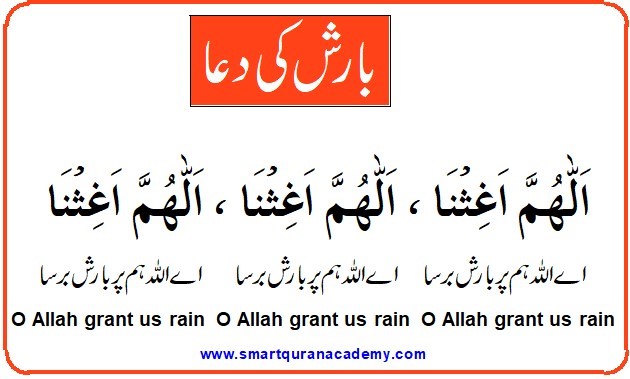
Meaning of Dua for Rain
This beautiful dua teaches Muslims to ask Allah for rain but to ask Him for rain that brings goodness and mercy.
Every word has a meaningful message:
- Allahumma—O Allah, Lord of the heavens and the earth.
- Asqina—Rain and water, give us. Ghaythan Mughithan – Rain that brings relief during hardship.
- Mari’an – Pure, sweet, wholesome rain.
- Mari’an—Rain that is fertilizing and fruitful.
- Nafi’an Ghayra Darrin—Rain that is useful but does not cause floods or destruction. ‘Ajilan Ghayra Ajil’ – Rain that comes soon, without delay or haste.
This dua teaches the believers to seek the blessings of Allah in a wise manner. Instead of asking just for rain, Muslims ask for rain that brings prosperity, healthy crops, clean water, and relief to all living things.
Benefits of Praying for Rain
The Dua for Rain is not merely asking for rain. It is a form of worship that helps cement the bond between a believer and Allah (SWT). In this prayer Muslims recognize that all blessings are from Him alone and that He alone has complete control over the heavens and the earth.
Here are some of the spiritual and worldly benefits of reciting this beautiful dua.
1. It Builds Trust in Allah (Tawakkul)
One of the biggest lessons of the rain dua is to rely fully on Allah. Muslims believe that Allah alone determines the time, place, and amount of rain, even if scientists may study weather patterns using scientific methods.
Reciting this dua reminds the believers to trust the wisdom of Allah and to keep making sincere efforts in their daily lives.
2. It Leads to Repentance
Floods make Muslims think about their deeds and ask for forgiveness from Allah.
Repeatedly, the Quran links the act of seeking forgiveness with the bestowal of Allah’s blessings. Thus, a lot of scholars suggest increasing Istighfar along with Dua for rain.
Repentance makes the heart soft, increases humility, and brings the believer closer to Allah.
3. It brings hope in difficult times
Communities hit by drought often face financial hardship, food shortages, and emotional stress.
When Muslims recite this genuine supplication, they are reminded that Allah’s mercy is limitless. Even though the situation is difficult, the believers do not lose hope in His help. This optimism is one of the beautiful features of Islamic faith.
4. It Unites Communities
During the performance of Salat al-Istisqa, Muslims come together in worship without consideration of class, wealth, or background. All are equal before Allah, who asks for His mercy and forgiveness.
This strengthens brotherhood, compassion, and unity within the Muslim community.
5. It Promotes Gratitude
Rain often passes without notice until it is absent. The Dua for Rain teaches Muslims to be thankful for all blessings, even things like clean water, healthy crops, rivers, animals, and food.
Gratitude itself is a worship that brings more blessings from Allah.
Salat al-Istisqa’ (Prayer for Rain)
- Prophet Muhammad (ﷺ) used to instruct the Muslims to make dua and also perform a special prayer known as Salat al-Istisqa in times of severe need for rain.
- This Sunnah prayer shows complete dependence upon Allah.
- Usually it is performed in an open area where Muslims come together as a community to seek Allah for beneficial rain.
- The Prophet (ﷺ) advised that people should approach this prayer with humility, repentance, and sincerity, not pride and worldly concerns.
How to Perform Salat al-Istisqa?
While the specifics may differ a little from scholar to scholar, the broad Sunnah consists of the following:
- To offer two rak’ahs like the Eid prayer.
- Listening to a sermon to remind people to seek forgiveness.
- Increasing Istighfar and Dhikr of Allah.
- Sincerely making dua for beneficial rain.
- Hands raised during supplication.
- Humility before Allah.
Many scholars also say that it is recommended to give charity before prayer and to reconcile with others, which increases sincerity.
Best Time to Recite Dua for Rain
The Dua for rain can be recited whenever rain is needed to bring the rain.
Suggested occasions are
- During drought
- before or after Salat ul-Istisqa.
- When you make personal du’a.
- In the last third of the night.
- Between the Adhan and the Iqamah.
- During fasting.
- Fridays, particularly the last hour before Maghrib
Many scholars also state that the dua may be recited at any time when supplications are accepted. The most important aspect is sincerity rather than restricting it to a specific time.
Key Takeaways
The Dua for Rain is a striking reminder that Allah alone governs the heavens and the earth. It
teaches Muslims to turn to Him, seek His pardon, and be grateful for every blessing. The believers continue to do sincere dua and put their trust in the perfect wisdom of Allah, no matter if the rain comes fast or after a while.
Please remember these crucial points:
- Rain is a mercy and blessing from Allah.
- The Prophet Muhammad (ﷺ) taught authentic supplications to request rain from Allah, which is beneficial.
- Salat al-Istisqa‘: the prayer for rain in times of drought.
- Sincere supplication is accompanied by repentance, charity, and gratitude.
- The rain dua can be recited by any Muslim, individually or in a congregation.
- Learning real duas strengthens faith and daily worship.
Understanding the meaning of this beautiful supplication, Muslims become more patient, grateful, and dependent on Allah at every stage of life.
Conclusions
Dua for Rain is so much more than a prayer for rain. It is a reflection of humility, hope, and complete dependence on Allah (SWT). Every drop of life-giving rain is a reminder of His unfailing mercy and His care for all creation. By learning the Arabic words, understanding their translation and reflecting on what it means, Muslims can make this supplication from the Sunnah sincerely and confidently.
Believers should increase repentance, make dua, perform righteous deeds, give thanks for the blessings of Allah, and trust that His decisions are always based on perfect wisdom. Whether drought or abundance of rain, the heart of a Muslim remains attached to Allah with acts of worship and thanks.
Frequently Asked Questions
1. Is there any truth to the “Rain Dua”?
Yes. The rain dua is a Sunnah of the authentic Sunnah. The Prophet Muhammad (ﷺ) used to teach the Muslims to ask Allah for rain that would be beneficial to them and used to conduct Salat al-Istisqa when there was a drought. This is a reminder to the believers to come to Allah with humility, trust, and real repentance whenever they seek His mercy.
2. Can I recite Dua for rain in English?
Yes. It is advisable to memorize and repeat the dua in Arabic, yet Allah understands all languages. If you do not yet know the Arabic language, you may truly ask Allah in your own language as you gradually learn the actual phrasing of the supplication.
3. Does saying the rain dua bring rain immediately?
Every sincere dua is answered by Allah in the best way according to His perfect wisdom. Sometimes rain arrives immediately, and sometimes Allah delays it, and no one knows the reason but Allah. The believer does dua with patience, hope, and full tawakkul on Allah.
4. What is the role of Muslims during a drought other than making dua?
Islam teaches that good deeds should be done with dua. This includes seeking forgiveness, doing charity, aiding the poor, conducting Salat al-Istisqa, expanding voluntary prayer, and being responsible with water. These are acts of sincerity and gratitude to Allah.
5. Is rain a gift in Islam?
Yes. The rain is considered one of the greatest signs and gifts of Allah in the Quran. It brings dead land back to life, gives us drinking water, grows our food, and keeps all living things alive. When it rains well, Muslims are instructed to thank Allah.
6. Do the children learn the rain dua?
Yes, definitely. Teaching kids simple duas of daily life builds a deep link with Allah from an early age. Parents should teach the dua of rain to children so they realize that all blessings come from Allah and they should turn to him in times of need.
7. Where can I learn more about real Islamic duas and Quran recitation?
One of the greatest ways to study authentic Islamic duas, Quran recitation with Tajweed, daily duas, and other essential Islamic knowledge is to join a trusted online Quran academy with certified lecturers. By learning continuously, children and adults will be able to build their faith and to follow Islam with confidence.
Learn Quran & Authentic Duas With Our Online Quran Academy
It’s more meaningful to understand Islamic duas when you learn directly from qualified teachers. Online Quran Academy is committed to building a strong bond between children, adults, and new learners with the Quran and Sunnah through one-to-one online classes at their convenience.
Our online Quran classes are for all ages and for all levels of students. If you are interested in learning the Quran online, improving your Tajweed, memorizing selected Surahs, studying daily duas, or increasing your Islamic knowledge, our experienced tutors provide personalized guidance in a supportive learning environment.