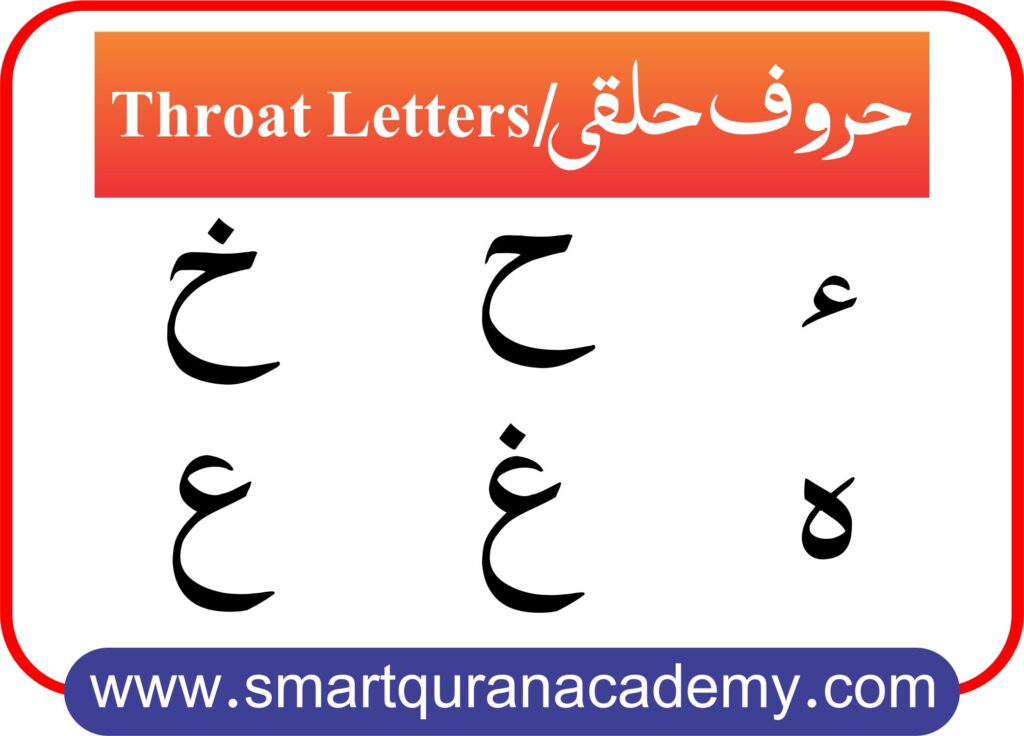
A quick look at the Tajweed guidelines is important for proper Quran recitation. Today, we’ll take a quick look at why Arabic throat letters need so much care while pronunciation. Here’s a word of caution. The Tajweed method of studying and learning the Quran is one way to approach it. It calls for having the manners to perform Wudu (wuzu) first and acting like an adult.
So, let’s get to know the Arabic alphabet properly. To pronounce throat Arabic letters, you need to know that Haroof signifies letters. Here, Harf is one letter, Halq is the throat, and Makhrij is the origin or “home” of a letter. Many English and Urdu speakers are not aware of these facts. Almost all of the mouth’s muscles and organs are involved while speaking Arabic.
Arabic uses all of the fundamental consonant and vowel sounds, with the exception of the letters “Puh,” “Cuh,” and “Guh.” Even the letter “X” exists as read in “Xiao.” Therefore, the 6 Arabic throat letters should be correctly read when reciting them. They must be spoken aloud while making the corresponding sound and using the appropriate muscle group.
There are a total of 6 Arabic throat letters that are spoken from the throat while reading or Quran memorization. Right now, we are going to mention them in detail. In this way, it will be easy for you to learn and remember them.
These are the letters residing at the top of your throat. Some people ask “what are the full mouth letters in Arabic?” Well, the full mouth letters in Arabic are as follows:
These are the letters which Makharij from the center.
These are the letters residing at the bottom.
Arabic throat letters are spoken by Makharij. Being able to pronounce Arabic characters properly is essential for us. Understanding the five primary makarij of the letters is important. The following are the top five makharij.
There are many people who are unaware that our nose plays an imperative part in pronouncing letters. When it comes to Arabic then there are two letters that are pronounced with the help of our nose. These letters include م and ن. We refer to it as ghunna when the sound of these two letters hits the nose. Did you notice that the sound is made with the lips and nose altogether? Try saying “mmmm”.
A number of letters of the Arabic language exit from our tongue. Not just that, there are 18 letters that exit from our tongue in Arabic. These letters include ق ك ش ج ي ض ل ن ر ط د ت ص ز س ظ ذ ث. These letters are then further broken down into certain makharij. They will therefore assist in your understanding of how each letter is pronounced.
The letters are the six that emerge from the throat. We rarely utilize our throats to pronounce any of the letters in Urdu or English. As a result, many people have trouble pronouncing the letters from the throat. You may need a lot of time to pronounce the word correctly.
The area in your mouth that is open is the empty space. Whenever a doctor instructs you to open your mouth, respond aaaaaa. Have you ever questioned the source of this sound? Your mouth’s open space is where the sound is coming from. The characters “alif madd,” “wow madd,” and “ya madd” come out of the empty space. Try saying aaaa, eeee, and oooo now, and then pause to consider where the sound comes from.
There are a total of 4 letters in Arabic that comes after Arabic throat letters that are pronounced from our lips. These letters include ف,ب ,م ,و.

Tajweed rules and guidelines include throat Arabic letters. Every Muslim who wants to read and recite Quran properly must know these throat letters. You can take help from the makhraj of Arabic letters pdf. In case you are not good at reading these throat letters then do practice on a regular basis.